
Picture two homes on the same block in Bakersfield. One sits twelve days, while the other sits five months, with the same square footage, the same schools and the same street trees. Price and condition explain nearly all of that gap, and almost nothing else does. So the question of how long to sell in California is less about the market than about the decisions you make before the sign goes in the yard.
How Long Does It Take to Sell a House in California
Anyone who quotes you a single number for how long to sell a California house is guessing.
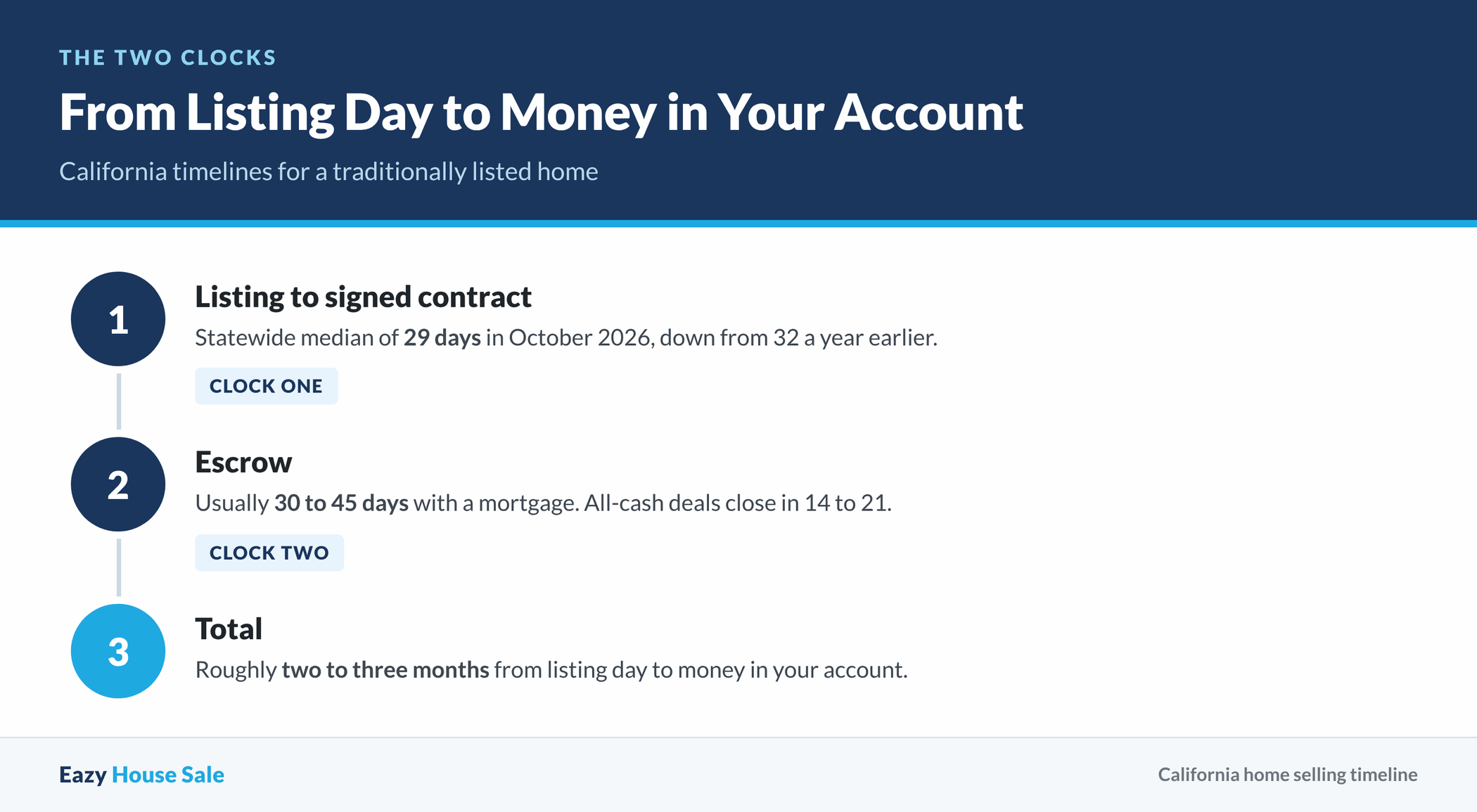
Two clocks run at once, and people mix them up all the time. The first measures how long your listing sits before a buyer signs. In its October 2026 report, the California Association of Realtors (C.A.R.) said the statewide median price slipped to $886,760, with a sales-price-to-list-price ratio of 98.5 percent. Homes that sold that month spent a median of 29 days on the market, down from 32 a year earlier.
Clock two is escrow. Once a buyer signs, a California sale with a mortgage behind it usually needs another 30 to 45 days from accepted offer to recorded close. Cash sales skip the lender’s appraisal and underwriting, so they can move much faster. Stack both clocks. The honest answer to how long to sell a home listed the usual way comes to roughly two to three months from listing day to money in your account.
That median, though, hides the people who are stuck. Half of California sellers wait longer than the midpoint, and some wait far longer.
Early last year I sat at a kitchen table in Fontana with a widow whose husband had handled everything. She had three contractor bids for a kitchen remodel her agent swore the house needed. Even the lowest bid cost more than the kitchen would add to her sale price. Her son had also been storing a boat trailer in the garage for six years, and that was its own kind of delay.
What do you do with a timeline like that when your roof leaks and your buyer pool shrinks to investors? You adjust the plan honestly. The gap between California’s published median and your own situation is where most of the frustration lives. Closing it is the first thing I try to do when somebody calls.
How Fast Is the California Housing Market Right Now
If you’re asking how long to sell this fall, you haven’t missed the window, though it has changed shape.
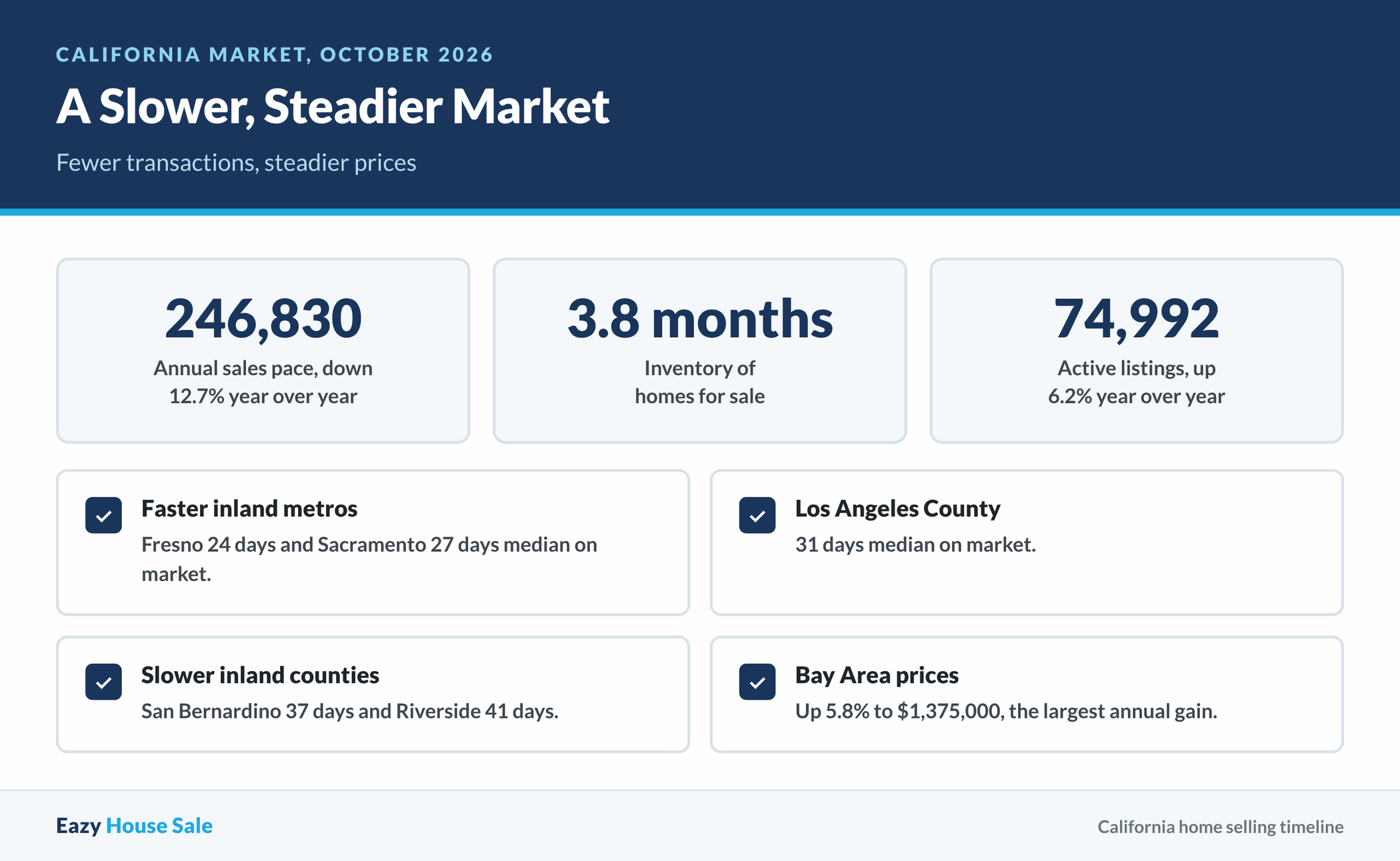
Sales volume has been thinning. Existing single-family sales in California fell 12.7 percent year over year in October 2026 to a 246,830 annual pace, the lowest in nearly three years. Inventory rose to 3.8 months. Fewer transactions, steadier prices. Prices aren’t getting crushed; sellers are just waiting through a quieter room.
Geography splits the state hard. In October 2026, Los Angeles County’s median time on market ran 31 days, while Riverside sat at 41, San Bernardino at 37, Sacramento at 27 and Fresno at 24. The Inland Empire moves slower than Bay Area headlines suggest. San Francisco Bay Area prices posted the largest annual gain that month, up 5.8 percent to $1,375,000, which keeps coastal pressure high and inland patience necessary.
Rates are doing the heavy lifting on buyer behavior. Freddie Mac’s 30-year fixed rate averaged 7.33 percent in October 2026, up from 6.86 percent in September, according to C.A.R.’s report. Every tick up thins the pool of people who can qualify for your house at your price. Your buyer isn’t shopping for a home. They’re shopping for a monthly payment they can survive.
Active listing counts tell the other half of the story. Statewide, active listings in October 2026 ran 6.6 percent higher than a year earlier. More houses are now chasing fewer buyers.
My read is that this market rewards realism and punishes anchoring to 2022 comps. Sellers who price to what a buyer can finance today still move in a reasonable window. Everyone else donates months to the MLS.
Does the Time of Year Affect How Quickly a House Sells in California
Spring listings sell fastest, so the advice goes, and you should wait until March if you can. The California data complicates that.
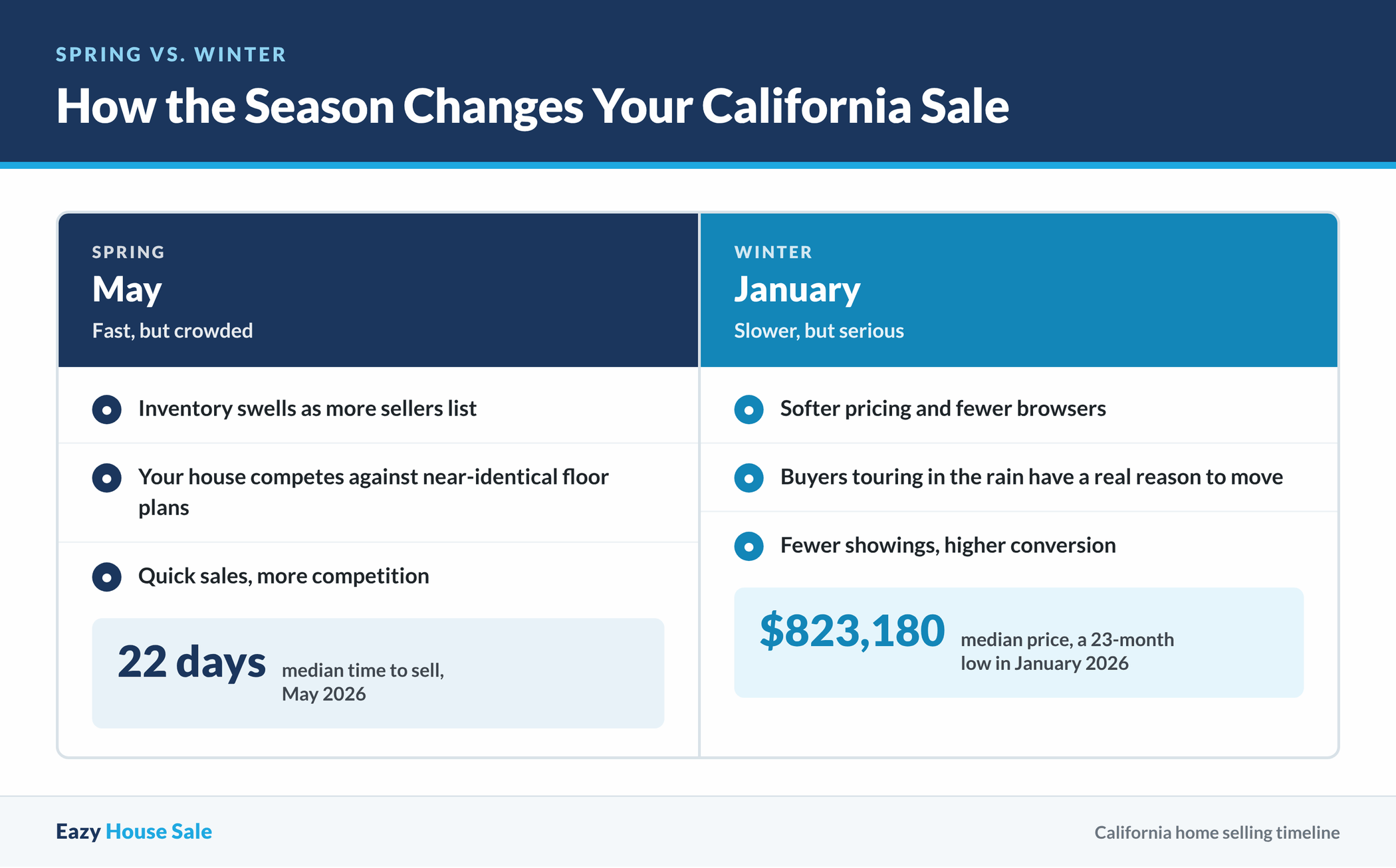
A California single-family home took a median 22 days to sell in May 2026, unchanged from a year earlier. That’s quick, sure. Every seller in Elk Grove and Temecula read the same advice, though, so May inventory swells and your house competes against a street’s worth of near-identical floor plans.
Winter cuts the other direction on price. California’s median home price fell to a 23-month low of $823,180 in January 2026 as market competition stayed cool. Slower season, softer pricing.
I part ways with the standard seasonal playbook on one point. A January buyer in California is a serious buyer. Nobody tours a house in Modesto during a rainstorm for fun. They’re moving for a job, or they’re already in escrow on a sale somewhere else. Fewer showings, higher conversion.
In parts of the state, fire season shapes how long to sell more than the calendar does. Listings in Sonoma, Napa and the Sierra foothills can stall when insurance carriers get cautious, and a buyer who can’t bind a policy can’t close.
Does your room to wait buy you anything? Maybe, if you can wait four months. Carrying two mortgages or facing a probate deadline turns waiting for the right season into a luxury. Holding a house for a better month can easily cost more than the premium that month delivers.
How Does Price Range Affect Days on Market in California
A couple in Riverside listed at the number their neighbor got in 2022 and sat eleven weeks with two showings. They cut once, properly, and had an offer that weekend.
Price band predicts how long to sell a California property better than anything else I track. In October 2026, the $2 million and up segment was the only price range where sales grew, and only by 0.7 percent. That sounds great until you see how slowly those homes sell. Luxury homes in Montecito or Hillsborough draw a tiny buyer pool, and that pool takes its time.
Affordability sets the speed limit. C.A.R.’s affordability index showed just 19 percent of California households could afford a median-priced home in the third quarter of 2026. A pool that small makes every price band thinner than it looks. Cheaper doesn’t always mean faster, either. San Bernardino County carried 5.3 months of unsold inventory in October 2026, so its lower prices still ran into plenty of competing listings.
Speed swings wildly across the state at the same moment. October 2026 data put San Mateo at an 11-day median and Alameda at 14. Mendocino ran 106 days and Napa 75. Same state, nearly ten times the wait.
Overpricing costs you more than time. Days on market is visible to every buyer and agent, and a listing that’s been up nine weeks starts drawing lowball offers.
One pattern I keep seeing is sellers who cut $10,000 at a time, three times, and end up below where a single honest correction would have landed them. Shaving in slices trains the market to wait you out.
What Slows Down a Home Sale in California
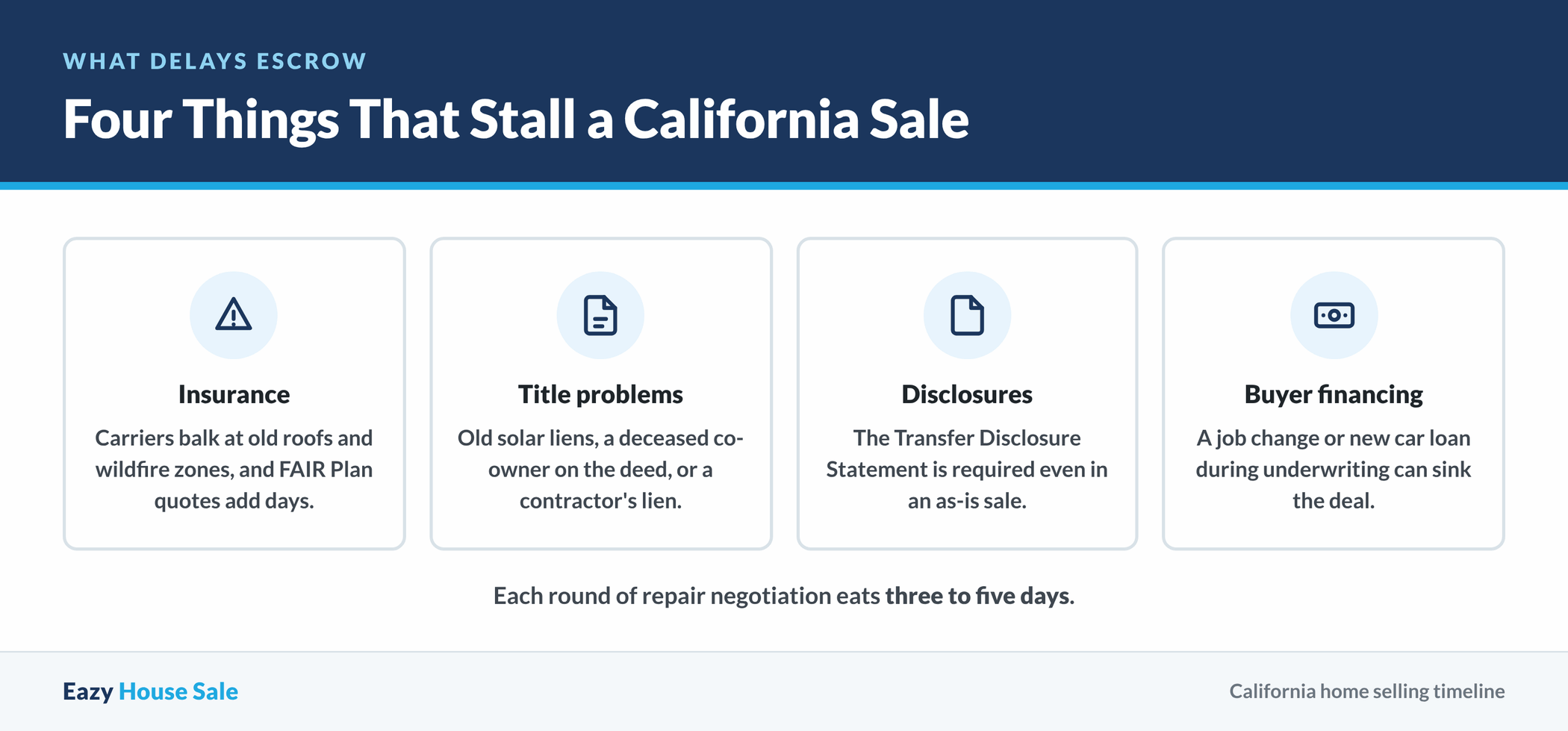
A seller I worked with lost her buyer two weeks before closing when the insurer refused to cover a roof it called too old. Insurance can sink a California escrow as surely as a bad appraisal, and nobody puts that in the listing pitch.
Carriers have pulled back from wildfire areas, so a buyer in Paradise or the hills above Glendora may spend days or weeks hunting coverage before a lender will fund. The FAIR Plan, the state’s insurer of last resort, exists for those homes, but quoting it adds days you didn’t schedule.
Then there’s title, where an old solar lien or a deceased co-owner who never came off the deed can surface. Escrow finds these partway through, and your close date slides.
There’s real paperwork involved too. Most California home sellers must give the buyer a Transfer Disclosure Statement under the rules that begin at Civil Code Section 1102. Section 1102.3 calls for delivery “as soon as practicable before transfer of title,” and the law voids any waiver, so an as-is contract doesn’t excuse it. Executors and trustees who sell while settling an estate or trust are generally exempt, though an heir selling in their own name doesn’t fit that exemption. Writing an honest TDS on a house you never lived in takes time, and guessing is how sellers get sued. The California Department of Real Estate’s consumer booklet on disclosures covers the basics, though it dates to 2005, so confirm specifics with an attorney.
Buyer financing falls apart a lot. A job change or a new car loan during underwriting can do it. Anyone who needs certainty about how long to sell won’t get it from a financed buyer.
Repairs requested after inspection are the slow bleed. Each round of negotiation eats days, and two rounds plus a re-inspection can push a 30-day escrow well past its date. Eazy House Sale buy around that whole sequence, and that’s the real value: not a higher price, a shorter and more predictable calendar.
What Can You Do to Sell Your California House Faster
For years I told sellers to fix the kitchen first. That was wrong for most of the houses I’ve bought.
Deferred maintenance that a buyer’s inspector will flag beats cosmetics every time. A working water heater and a roof without active leaks remove objections. Fresh backsplash tile just photographs well.
Pre-listing inspections speed things up more than any upgrade. You pay a few hundred dollars to learn what the buyer’s inspector will find, then price with that knowledge instead of haggling again in week three. Sellers hate this advice because it feels like handing the buyer ammunition. It isn’t. You’re buying back your closing date.
Saying yes to the buyer’s timeline can shave real time off how long to sell. When a buyer needs extra time because of a VA loan, agreeing beats waiting for a cleaner offer that may not arrive.
Clean out the garage before listing photos. I’ve walked into houses in Stockton where the listing photos showed boxes to the ceiling. Those listings sat for weeks longer than they needed to, because buyers couldn’t see the room.
Price it at a search break. Listing at $852,000 instead of $849,000 removes you from every buyer whose filter caps at $850,000, and that mistake costs weeks.
If you need a date certain, a direct sale takes the lender and the repair haggling out of the equation at once. Eazy House Sale works with California homeowners in exactly that spot, and a cash close can land quickly when title is clean.
Frequently Asked Questions About Selling Time in California
What Is the Hardest Month to Sell a Home in California?
December and January are the slowest stretch in most of California, and the price data from this past winter backs that up. Holiday distraction and rain in the northern counties both thin out buyer traffic. Buyers who do tour in winter tend to be committed rather than curious, so the showing-to-offer ratio holds up better than the raw traffic suggests.
Can You Sell a House in California Without a Realtor?
Yes, and plenty of California homeowners do. You still owe the same disclosure package described earlier, and you’ll still need an escrow or title company to handle the money and the recording. If anything about the title is unusual, have a real estate attorney review the sales contract. Selling to a direct buyer removes the listing side entirely, which is a different route than a for-sale-by-owner listing where you market to retail buyers yourself.
Does How Long to Sell a California House Change If the Property Is Inherited?
Usually yes, and the holdup is rarely the market. Probate court timing and the cleanout of a house nobody has lived in for years can add weeks before you list, especially when several heirs have to agree. Once the estate is cleared to sell and the heirs are aligned, the marketing clock runs about the same as any other California listing in that price band and condition.
What’s the Fastest How Long to Sell a California House Can Realistically Be?
With clean title, no liens and a buyer who isn’t using financing, a California sale can record in roughly one to two weeks. The limits are the title search, the escrow company’s workload and how quickly you sign and return documents. Anyone promising a close in 48 hours is either skipping title work or not telling you the whole story.
If you’re weighing a traditional listing against a direct sale and you want someone to walk the numbers with you, we’re glad to do that. Tell us what the house is and what your timeline looks like, and we’ll give you a straight read on both paths, including the one that doesn’t involve us. No pressure, no obligation, and no hard feelings if you decide listing is the better move for your situation.
Plan Your Timeline With Eazy House Sale
Every sale runs on its own clock. Contact Eazy House Sale with your address and your timeline, and we’ll walk you through both a listing and a direct sale. You can also fill out the form below to get a cash offer with no obligation.