
A sofa sitting in a Burbank warehouse earns its owner rent whether or not your house sells. This single fact explains most of what confuses sellers about the cost to stage a house in California, because you’re not buying furniture, you’re renting a mood by the month. Pull that thread and the whole pricing structure starts making sense. I’ve bought houses up and down this state, from inland tract homes to beach bungalows, and I’ve watched sellers spend wisely on staging and I’ve watched them light money on fire. The difference usually came down to understanding what they were paying for before they signed.
What Does Home Staging Include?
Stagers charge you twice: once to put the furniture in, and again every thirty days it sits there. The second charge is the one that quietly reshapes the cost to stage a house when a California listing lingers.
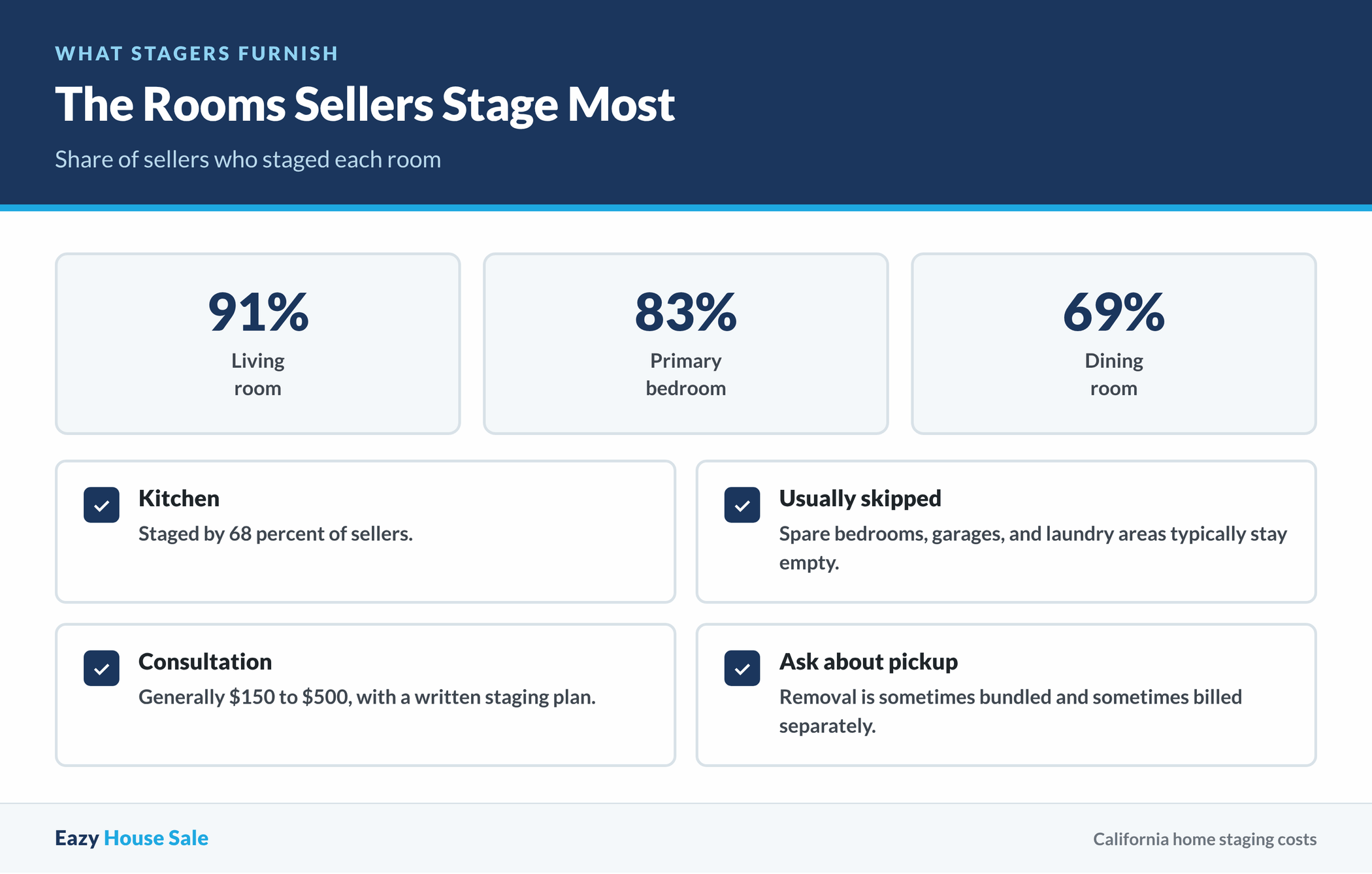
A full-service job usually starts with a walkthrough. Your stager tours the property, takes measurements, photographs rooms, and writes up a plan naming which spaces get furnished and which get left alone. Consultations generally run between $150 and $500 and come with a written staging plan. Some California stagers credit that fee back if you hire them for the full job, so it’s worth asking before you book. Plenty won’t volunteer the offer.
Installation day is where the labor cost lives. A truck pulls up, a crew carries in sofas and beds and nightstands, and designers spend hours placing art, rugs, lamps, and the bowl of fake lemons every stager in California seems to own. Then they leave, and your inventory rental clock starts ticking.
Staging crews don’t bother with every room in the house. Among sellers, the rooms staged most often are the living room at 91 percent, the primary bedroom at 83 percent, the dining room at 69 percent, and the kitchen at 68 percent. Spare bedrooms, garages, and laundry areas typically stay empty. That’s deliberate, not lazy.
When a house is occupied, staging works differently. The stager uses what you already own, edits out family photos and the recliner nobody likes, then brings in accent pieces to fill the gaps. Vacant staging means everything arrives on a truck. Virtual staging skips physical furniture entirely and drops digital furnishings into listing photos, which California agents use often on condos and smaller inland properties.
Something worth asking about up front: who pays for pickup. Deinstallation is sometimes bundled, sometimes billed separately, and I’ve seen California sellers surprised by a removal charge at closing because nobody wrote it into the agreement.
How Much Does It Cost to Stage a House in California?
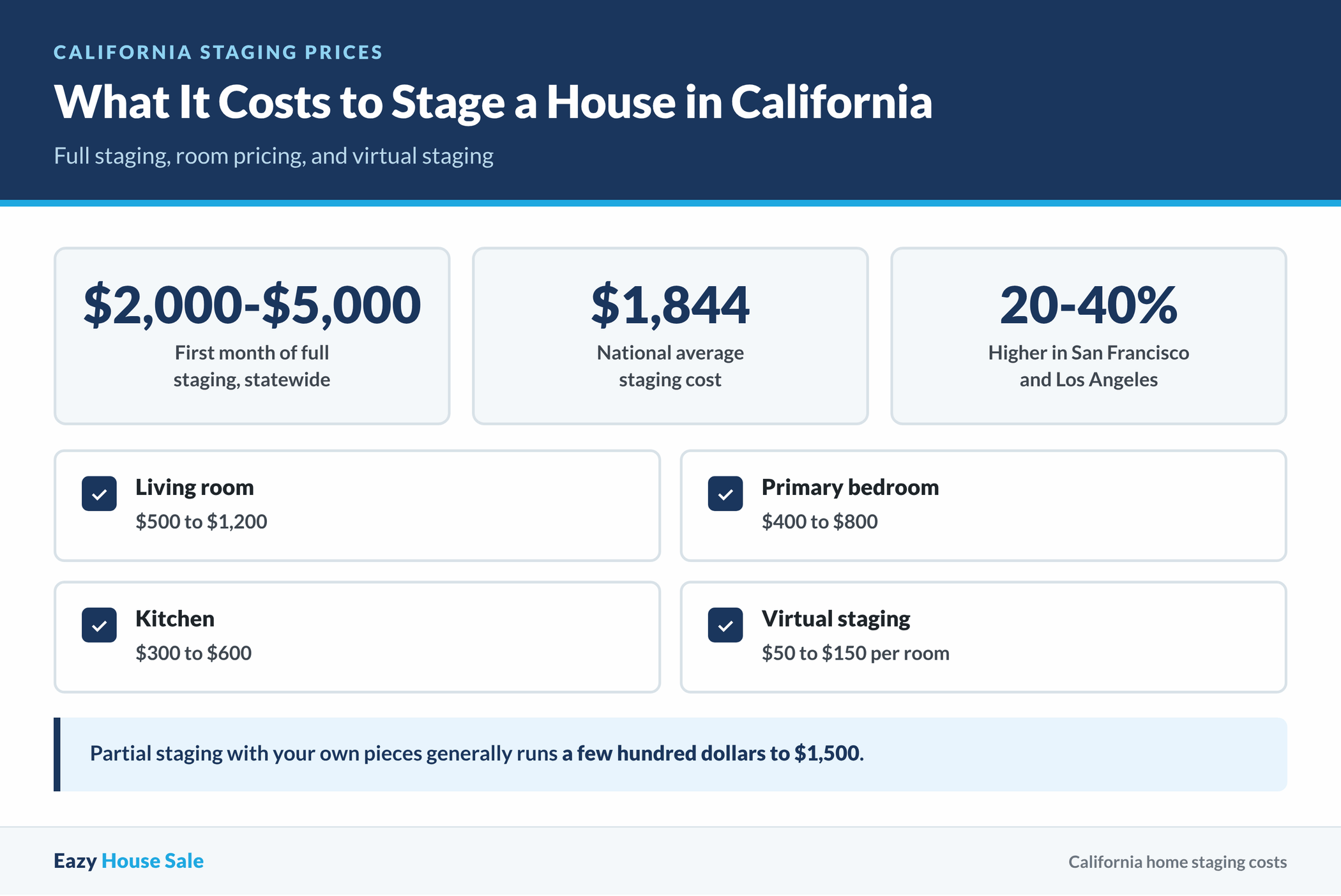
Two thousand dollars to five thousand dollars for the first month of full staging with rented furniture, and that’s the going range statewide. Monthly rental after that runs a fraction of that initial cost. Partial staging using your own pieces lands lower, generally a few hundred to $1,500.
California pricing sits above the national line, and not by a little. Expensive metros including San Francisco and Los Angeles run roughly 20 to 40 percent higher than the $1,844 national average. Warehouse space in the Bay Area costs what it costs, so your stager passes it along.
Room-by-room pricing helps when your budget is tight. A living room runs $500 to $1,200, a primary bedroom $400 to $800, and a kitchen $300 to $600. Dining rooms and home offices fall in similar territory.
Going digital changes the math completely. Virtual staging costs $50 to $150 per room and makes sense for online listings. For a Fresno or Bakersfield seller trying to compete on photos alone, that’s often the smarter call. I’d rather see a seller spend $400 on virtual images than $4,000 on a house that was never going to photograph well anyway.
Last year I worked with a family in Rancho Cucamonga who’d watched two agent listings expire back to back without a single offer. Their garage still held the staging company’s leftover throw pillows and a stack of unused sign riders from the second attempt. They’d paid the cost to stage a house twice over and, when I walked through that garage myself, it was clear they had nothing to show for it.
What should you budget? For a mid-sized California home sitting in a normal neighborhood, plan on the first month plus two more months of rental, and treat anything cheaper as a happy surprise.
What Factors Affect the Cost to Stage a Home in California?
A widow in Chico called me after her stager quoted nearly three times what her neighbor had paid in the same subdivision. Her house was vacant; the neighbor’s wasn’t.
Occupancy swings the number harder than anything else. When your furniture stays, the stager rents you accessories and labor. When the house is empty, every item in every photographed room comes off a truck.
You should care less about square footage than you’d guess. Most stagers price by room rather than by total size. A 2,800 square foot California ranch with four stageable spaces can cost less than a cramped 1,600 square foot Victorian with seven.
Where you are in California changes the bill plainly. Coastal Orange County and Marin stagers carry upscale inventory and charge accordingly. Head east toward Riverside, Stockton, or Redding and the cost to stage a house drops, partly because warehouse rent falls and partly because buyer expectations shift.
Time on market is the sleeper variable. California homes sold in a median of 29 days in October 2026, down from 32 days a year earlier, with the statewide median price holding at $886,760. That’s listing-to-contract, though. Add escrow and your furniture may sit for ten or eleven weeks.
Price tier pulls everything upward. A $3 million Montecito listing gets designer inventory; a $450,000 Hemet house gets practical pieces.
Your home’s architecture plays a role too. Mid-century properties in Palm Springs and Eichlers on the Peninsula need period-appropriate furniture that fewer California warehouses stock, and scarcity costs money. I’ve seen stagers add a surcharge for anything requiring a specialty sourcing run.
Stairs, narrow driveways, and hillside access in places like the Oakland hills add labor hours. Crews bill for difficulty.
What Mistakes Drive Up Home Staging Costs?
You don’t need to stage the whole house. I say that to California sellers constantly, and about half of them do it anyway.
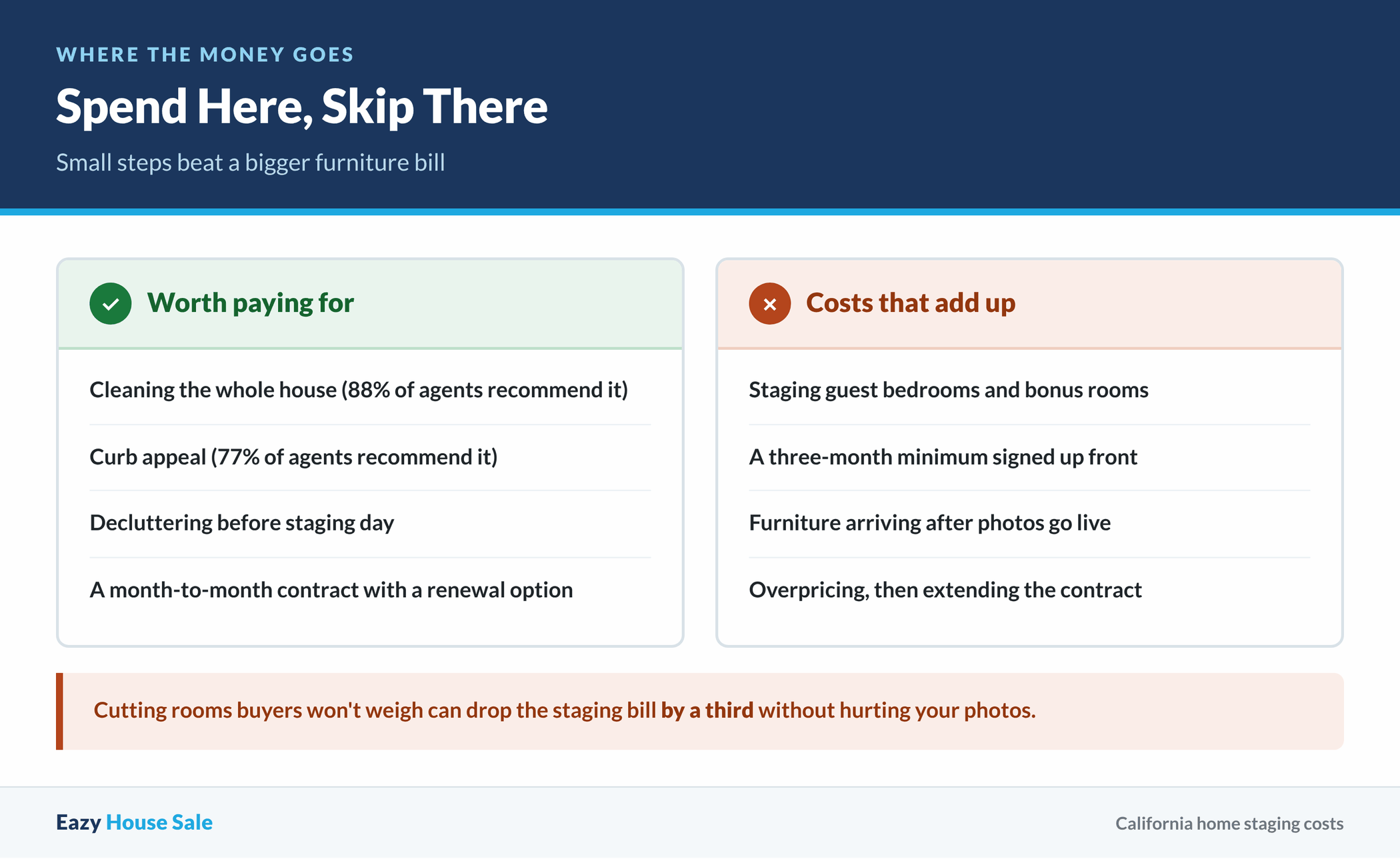
The most expensive mistake I see is sellers staging rooms buyers won’t weigh heavily. Guest bedrooms, bonus rooms, and finished basements rarely move a decision, yet sellers pay monthly rental on all of them. Cut those and the cost to stage a house in California drops by a third without hurting your photos.
Signing a long contract before you understand your pricing is another trap. Some stagers push three-month minimums. If your California agent prices the house right, you may not need month three, so negotiate a month-to-month arrangement with a renewal option instead.
Waiting until the house is already listed costs real money. Furniture that arrives after photos go live means reshooting, and reshoots mean paying your photographer twice.
Skipping cleaning and repairs before staging day is backwards. A crew will set a beautiful sofa in front of a stained wall, and buyers will see the stain. Agents most commonly recommend decluttering, cleaning the whole house at 88 percent, and improving curb appeal at 77 percent. Those three cost almost nothing compared to furniture rental.
Overpricing the house and then blaming the staging is the pattern I run into most. A seller lists $80,000 above comps, sits unsold for sixty days, extends the staging contract twice, then drops the price anyway. The furniture never had a chance.
One more: letting your stager pick inventory that fights the house. Coastal-casual furnishings in a Sacramento Tudor read as confused, and confused listings sit. For California homeowners who’d rather skip the whole exercise, Eazy House Sale buys properties in their current condition, no staging budget required.
How Can You Lower the Cost to Stage a House?
An heir in Modesto quoted $5,200 for full vacant staging instead spent about $900 on a consultation, a deep clean, and three rented rooms. She closed in five weeks at her asking number.
Partial staging is what I usually recommend to California sellers. Furnish the living room, primary bedroom, and dining area; leave the rest empty and clean. Empty rooms photograph fine when the floors are spotless and the paint is fresh.
Hire a consultation only and do the work yourself. For $200 or $300, a California stager will hand you a room-by-room plan you can execute with your own furniture over a weekend. That cuts the cost to stage a house down to almost nothing.
Negotiate the monthly rate, not the setup fee. Stagers have more flexibility on recurring rental than on labor, and California warehouses would rather have inventory earning something than sitting idle.
Rent furniture directly. Furniture rental companies across California lease sofas and beds for less than a stager’s marked-up rate, and if you’ve got an eye for arrangement, you can place it yourself.
Have you considered whether your house needs staging at all? Homes in hot California submarkets with low inventory sometimes sell on day three regardless, so staging might not even factor into the outcome. Ask your agent about the last five comparable sales nearby and how many were staged.
Timing helps too. California listings that go up in spring tend to move faster, which trims the number of rental months you’ll pay for.
Do Realtors Cover the Cost to Stage a House?
Assume your agent is paying and you may get a bill you never budgeted for, three weeks before closing, when your cash is already committed.
Practices vary widely across California brokerages. Among sellers’ agents, 26 percent said staging compensation depends on the situation. Translation: it’s negotiable, and it’s rarely automatic.
High-producing agents in competitive California markets like Palo Alto or Manhattan Beach sometimes front staging costs on expensive listings, then recoup them from commission at closing. It’s a loan, not a gift. Read the listing agreement language.
Many agents won’t stage at all. Over half of sellers’ agents, 51 percent, said they didn’t stage before listing but suggested the seller declutter or fix property faults instead. That’s not laziness; it’s an honest read on where the money works.
Some California brokerages run concierge programs that advance staging and repair costs, settling up at closing. Those programs can be useful, though the fine print sometimes includes fees if the house doesn’t sell, so get the terms in writing before you commit to anything.
What I’d ask any California agent before signing: who pays for the first month, who pays for extensions, and what happens if the listing expires with furniture still in the house. Those three answers tell you everything about how the cost to stage a house will land on your side of the ledger.
Agents who stage personally spend less. NAR found a median of $1,500 when sellers used a professional staging service, compared with a fraction of that when the listing agent did the staging themselves. A tasteful agent with access to a storage unit can get you most of the benefit.
Is It Worth Paying the Cost to Stage Your Home?
Will I get my money back?
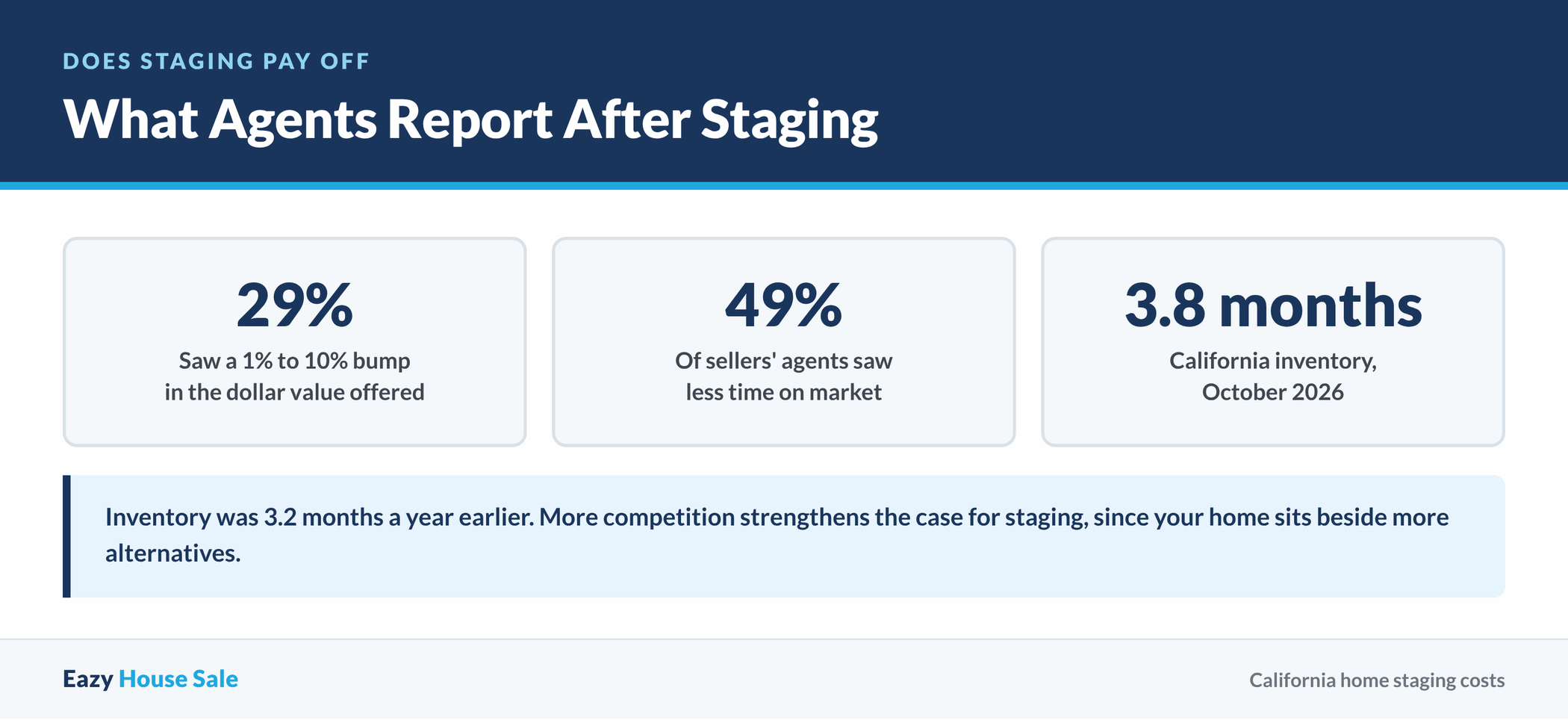
Sometimes. Nearly three in ten agents, 29 percent, said staging produced a 1 to 10 percent bump in the dollar value offered, and 49 percent of sellers’ agents saw staging reduce time on market. Flip that around and a majority of agents didn’t report a price increase at all.
My opinion, formed over a lot of closings: staging pays on vacant homes and on anything above the local median, though below median the return thins out fast if furniture’s already in place. California buyers shopping inland homes are looking at the layout and the commute, not the throw blanket.
Condition beats decoration every time. A staged house with a failing roof still reads as a project. I’ve watched California sellers spend four figures on furniture while deferring a $600 water heater repair that killed the inspection anyway.
You need to weigh market conditions here. Inventory across California climbed to 3.8 months in October 2026, up from 3.2 months a year earlier. More competition generally strengthens the case for the cost to stage a house, since yours sits beside more alternatives.
A homeowner in Vacaville reached out while moving her father into assisted living. His workshop filled the garage, decades of tools on pegboard. She couldn’t picture clearing it, cleaning it, staging it, and holding it open on Sundays while managing his care. So she sold as-is and spent her Saturdays with him instead. Sellers in that spot often find a direct buyer like Eazy House Sale makes more sense than any staging budget.
Frequently Asked Questions About the Cost to Stage a House in California
I used to tell every seller to stage. Experience taught me that advice was wrong about half the time.
How Much Does Staging Cost on a Typical California Listing?
Expect the full-staging figures quoted earlier in this article, with coastal metros landing at the top of each range and Central Valley cities at the bottom. Your actual number depends mostly on how many rooms get furnished and how many months the house sits. Get two or three bids before you commit; California stagers price differently from one another, and the spread on an identical house can be wide.
What Does It Cost to Build a 2,000 Square Foot House in California?
New construction and staging are entirely different budgets, and the build side is the larger one by a wide margin. California construction costs are driven by land, permits, seismic and energy code requirements, and labor rates that vary enormously between the Bay Area and the Inland Empire. Your city or county building department can point you to current permit and plan-check fee schedules, and a licensed general contractor in your area is the only reliable source for a real per-square-foot estimate.
What Should You Avoid Doing When Staging a House?
Don’t leave personal items in place. Family photos, religious objects, prescription bottles, and mail with your name on it all pull a buyer out of the daydream you just paid for. Avoid overcrowding rooms with furniture to make them look full, since California buyers reading listing photos judge space first. Skip bold paint colors, strong air fresheners, and anything that signals deferred maintenance sitting next to pretty furniture.
Can You Stage a House Yourself in California?
You can, and plenty of California sellers do it well. Clear out roughly half of what’s in each room, scrub everything, open the blinds, and keep the color palette quiet. Pay for one consultation if you can afford it, because a trained eye will catch the three things you’ve stopped seeing after living there fifteen years.
Does Staging Help More in Slow California Markets?
It tends to, yes. When buyers have options, presentation carries more weight, and the cost to stage a house becomes easier to justify against a longer holding period. In a fast submarket with almost nothing for sale, a clean and empty house often performs nearly as well as a furnished one.
Is There a Way to Sell Without Paying the Cost to Stage a House in California?
There is. Selling directly to a buyer who purchases as-is removes staging, repairs, showings, and the monthly furniture rental from the equation entirely. You’ll typically trade some price for that convenience, so run both numbers honestly: the net after staging, commissions, and carrying costs versus the direct offer in hand.
If you’re weighing the cost to stage a house against just selling the place as it stands, we’re glad to talk it through with you. No pressure, no obligation, and no hard feelings if you decide listing with an agent is the better road for your situation. Reach out at eazyhousesale.com whenever you’re ready, or just to get a straight answer about what your California house might be worth today.
Get a Straight Answer From Eazy House Sale
Not sure staging is worth it for your house? Contact Eazy House Sale and we’ll help you compare the cost of staging and listing against a direct sale. You can also fill out the form below to get a cash offer with no obligation.