

A mortgage statement arrives. Bold and prominent, the payoff figure sits there, and the Zillow estimate on your phone sits lower. This gap is the whole problem, and it’s the reason thousands of Californians quietly look up whether they can sell for less than the balance on their loan without wrecking their finances. Yes, in short. The longer answer involves your lender’s written consent, a state law that protects you better than almost anywhere else in the country, and a tax rule that changed recently.
I buy houses across California, and I’ve walked plenty of owners through this exact math. Let me show you how it works.
What Does It Mean to Owe More Than Your House Is Worth in California?
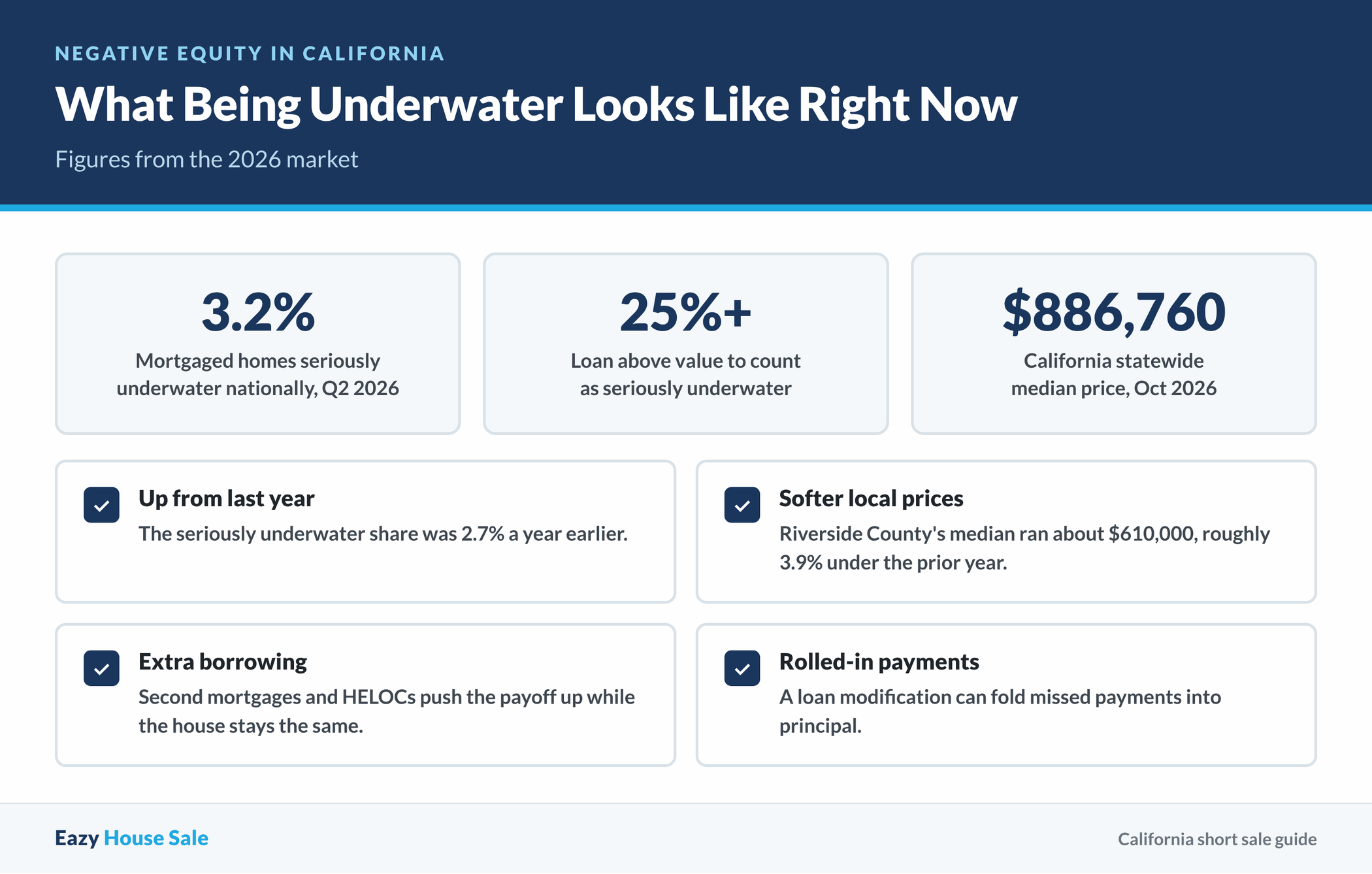
…and that gap has a name: negative equity. Your loan balance sits above what a buyer would pay. Appraisers call it being underwater. ATTOM’s second-quarter 2026 data put 3.2% of mortgaged homes nationally in the “seriously underwater” category, where loan balances run at least 25% above estimated value, up from 2.7% a year earlier. That’s not a crash. But it’s a real shift, and it’s showing up in California neighborhoods that saw big price runs in 2021 and 2022.
California has an unusual version of this problem because of scale. The statewide median price in October 2026 was $886,760, down 1.4 percent from September and basically flat against a year earlier. At that price point, a 5 percent dip is more than forty grand, which stings a lot more than the percentage alone suggests. Owners in Riverside County felt it directly: the median single-family price there ran about $610,000, roughly 3.9% under the prior year’s figure.
Negative equity doesn’t always come from falling prices, though. Second mortgages, HELOCs taken out during a renovation, deferred maintenance, a loan modification that rolled missed payments into principal: all of these push the payoff number up while the house stays the same. I’ve seen owners in perfectly nice Sacramento suburbs discover they owe more than a buyer would pay, not because their home lost value, but because they borrowed against it twice.
A few years back I worked with a widow in Hemet whose husband had refinanced before he passed. She watched two agent listings expire with zero offers, the second one over a rainy winter when the backyard pool sat green and nobody wanted to look at it. There wasn’t enough equity to pay commissions, and nobody had told her that upfront.
How Do You Find Out How Much You Still Owe on Your Mortgage?
Call your servicer and ask for a payoff demand statement. Not your balance. The payoff.
You should care when those two numbers differ, since you may have to sell for less than the loan. Your monthly statement shows principal as of the last cycle, but a payoff statement adds accrued interest through a specific date, any late fees, escrow shortages, and a recording or reconveyance charge. In California, that document is usually good for a set window, after which you request a fresh one.
Got a second lien? Pull that payoff too. Home equity lines are the quiet killer in these deals, because owners forget them until the title report surfaces a recorded deed of trust from 2006.
Then you need the other half of the equation: what the house is genuinely worth today, not what your neighbor listed at. Pull three to five closed comparable sales within a mile, from the last ninety days, with similar square footage and condition. I’ve seen deals fall apart over comps that were too old or too far away. Statewide, homes sold in a median of 29 days in October 2026, faster than the 32 days recorded a year before, so recent closings are easy to find in most metros.
Do the math without flinching. Loan payoffs plus selling costs on one side, realistic sale price on the other. If the first number wins, you’re looking at a sale for less than you owe, and you should know that before an agent talks you into a listing price nobody will pay.
Want to skip the guesswork? A written offer from a direct buyer like Eazy House Sale gives you a real number to subtract from, and you’re under no obligation to take it. I’d rather an owner have a hard figure than a hopeful one. California sellers who do this arithmetic early tend to make calmer decisions three months later.
Why Do California Homeowners Sell for Less Than They Owe?
Most people in this spot didn’t do anything wrong.
Life events drive the majority of these sales, which means the reasons rarely have anything to do with the house itself. Divorce splits a household that could carry one mortgage payment but can’t carry two rents plus a mortgage. A job transfer to Austin or Phoenix arrives with a 60-day start date. Medical bills stack up. An inherited property in Bakersfield comes with a reverse mortgage balance that nobody in the family can service.
A lot of this comes down to when buyers bought. Buyers who stretched at the peak in the Inland Empire or the Central Valley, often with minimal money down, are the most exposed when values flatten. The Inland Empire median landed at $577,440 in October 2026, down 3.7% year over year, and Los Angeles came in at $827,750, off 2.5%. Small percentage declines, big dollar swings.
Then there’s the cost side that owners underestimate. Insurance premiums in fire-exposed foothill communities have climbed hard. Special assessments hit condo owners in older coastal buildings after balcony inspections. Property taxes on a 2022 purchase reflect that purchase price, not today’s value, and the reassessment process takes work.
The monthly bill can jump without much warning. Adjustable loans, interest-only periods ending, and forbearance balances coming due all land as a sudden monthly increase. When the payment jumps and the equity isn’t there, choosing to sell for less than the mortgage balance stops being a defeat and starts being a plan.
One pattern I keep seeing across California: owners wait too long. They hope for a spring bounce, miss three payments, and then face both negative equity and a notice of default. The second problem is harder than the first.
Can You Sell a House for Less Than You Owe in California?
A seller in Fontana owed about twelve percent more than her best offer. Six weeks after her lender signed the approval letter, she walked away owing nothing.
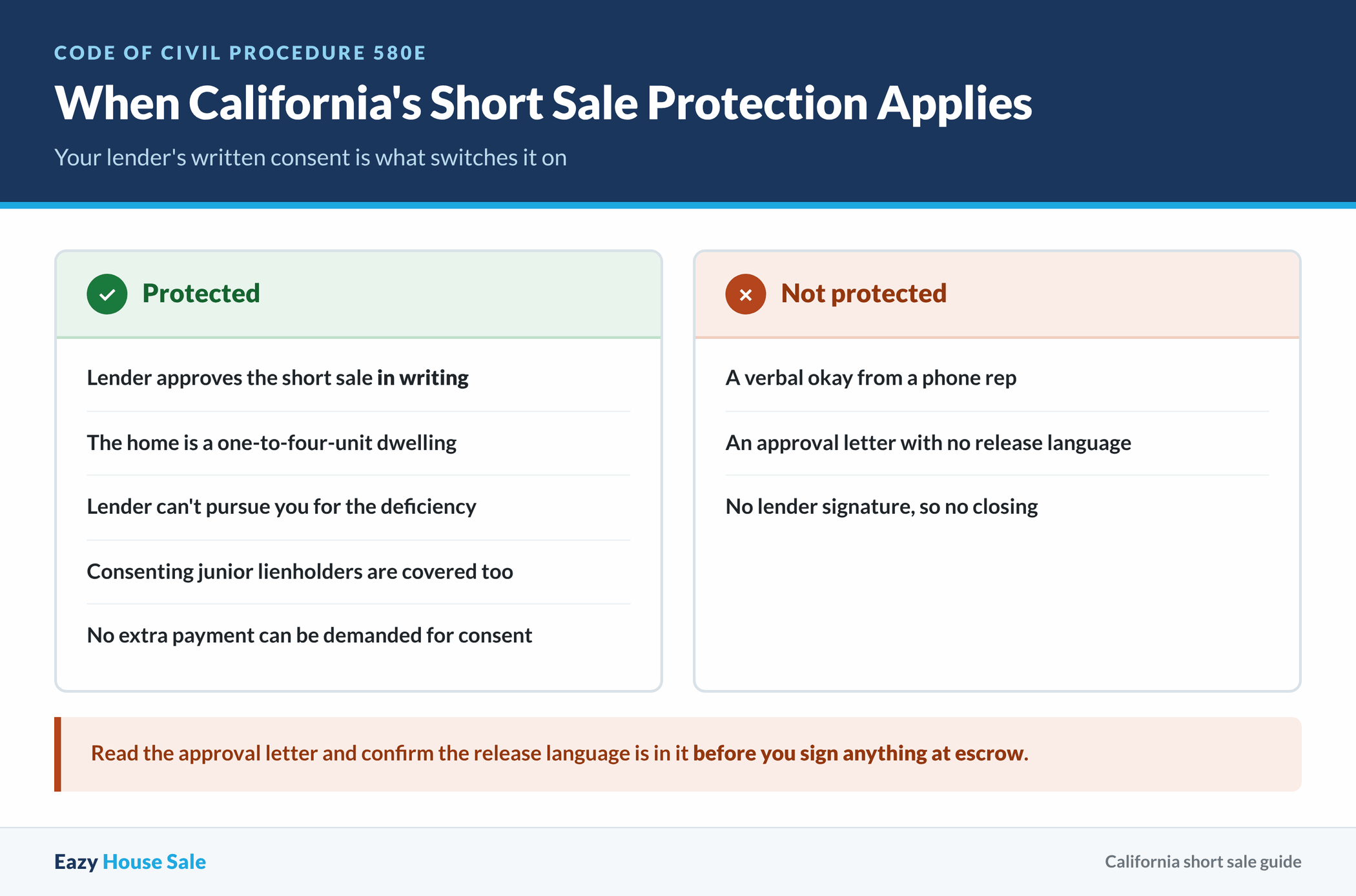
California allows a short sale, yes, indeed. Your lender has to consent in writing, because they’re agreeing to release their lien for less than full payoff. No lender signature, no closing. Title can’t transfer with an unsatisfied deed of trust attached.
Here’s where California protects you more than 40 other states do. Under Code of Civil Procedure Section 580e, once a lender approves a short sale on a one-to-four-unit dwelling, it can’t pursue you for the deficiency. Junior lienholders that consent to the sale receive that protection. The statute also bars the noteholder from demanding extra compensation beyond the sale proceeds in exchange for consenting. You can read the section text at Justia’s California code database.
Does that mean every underwater sale is safe? No. The protection only activates when the lender formally consents in writing to the short sale, and a verbal okay from a phone rep doesn’t count as consent. Read the approval letter, and confirm the release language is in it before you sign anything at escrow.
There’s another route to sell for less than your balance, and it’s simpler: bring cash to closing. If you owe forty thousand more than the house fetches and you have forty thousand, you write the check and you’re done. Most California owners in this position don’t have that, which is why the short sale path exists.
What Happens If You Sell Your House for Less Than You Owe?
A Stockton couple closed their short sale in August and thought they were finished. In January a Form 1099-C showed up in the mailbox, and suddenly they had a tax question nobody had raised at escrow.
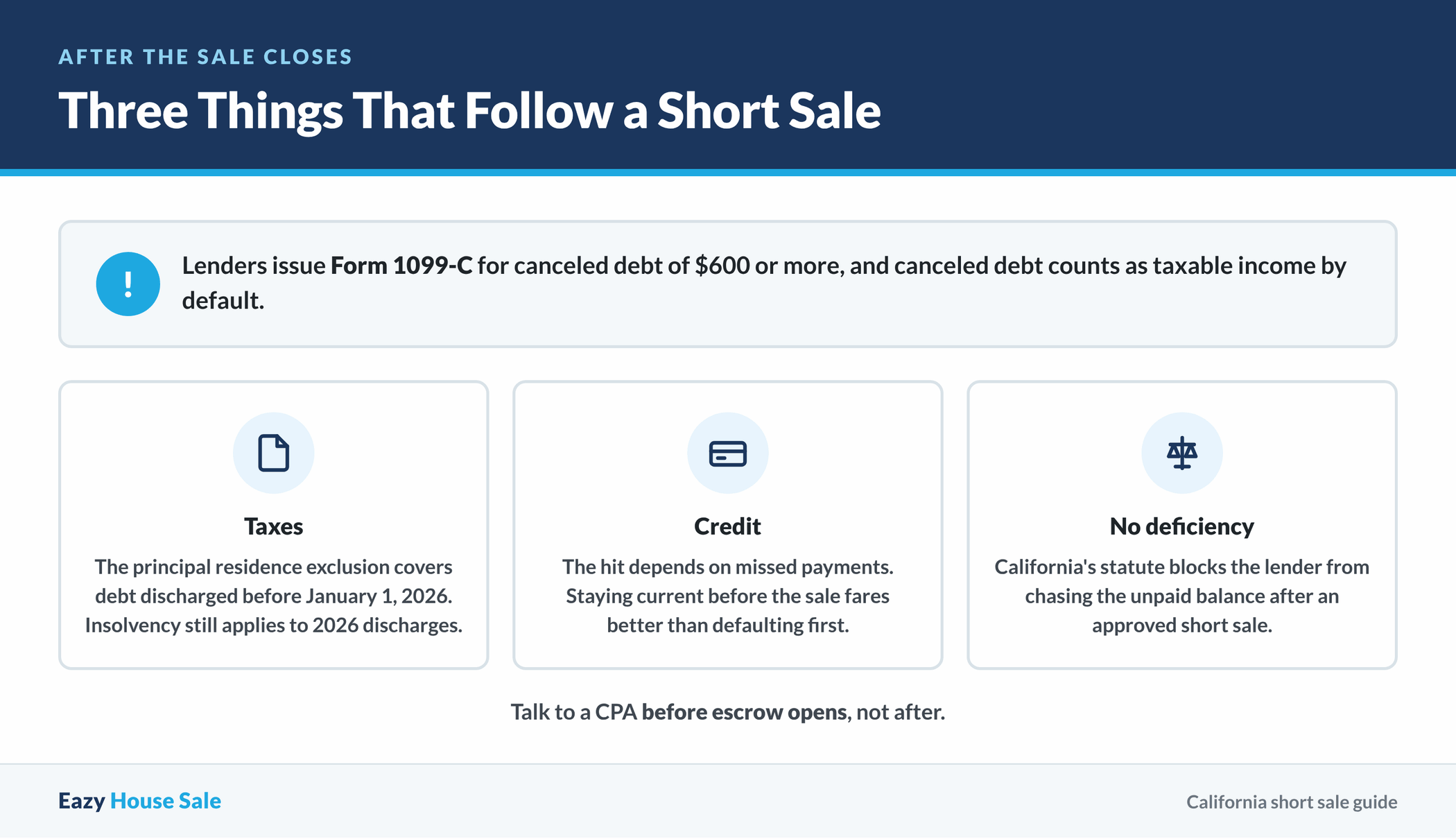
People tend to miss this part of the process. When a lender forgives part of what you owe, they’re required to issue Form 1099-C for canceled debt of $600 or more, and the default rule is that canceled debt counts as taxable income.
There used to be a reliable escape hatch for homeowners. The qualified principal residence exclusion let people leave forgiven mortgage debt off their return. But the IRS states it applies to debt discharged before January 1, 2026. It also applies to debt discharged under an arrangement entered into and evidenced in writing before that date. The agency’s own summary sits on IRS Topic No. 431. If you’re closing a California short sale now, talk to a CPA before escrow opens, not after. Exactly that timing detail is what I’ve seen trip up sellers who assumed the old rule still covered them. Other exclusions still exist: bankruptcy, insolvency, qualified farm debt, and qualified real property business debt all apply to 2026 discharges, and insolvency is the one that helps the most underwater homeowners.
Your credit takes a hit too. How big depends on whether you missed payments leading up to the sale. An owner who stays current and closes a short sale fares better than one who defaulted first, and both fare better than a completed foreclosure.
What you avoid is a deficiency chasing you for years. California’s statute does that work, and it’s the single strongest reason to sell for less than you owe rather than let the house go to a trustee’s sale.
What Are Your Options Besides Selling for Less Than You Owe?
“Why wouldn’t I just refinance and wait it out?”
Because lenders underwrite to value, and you don’t have any. A conventional refinance needs equity you no longer hold. That door is usually closed before you knock on it.
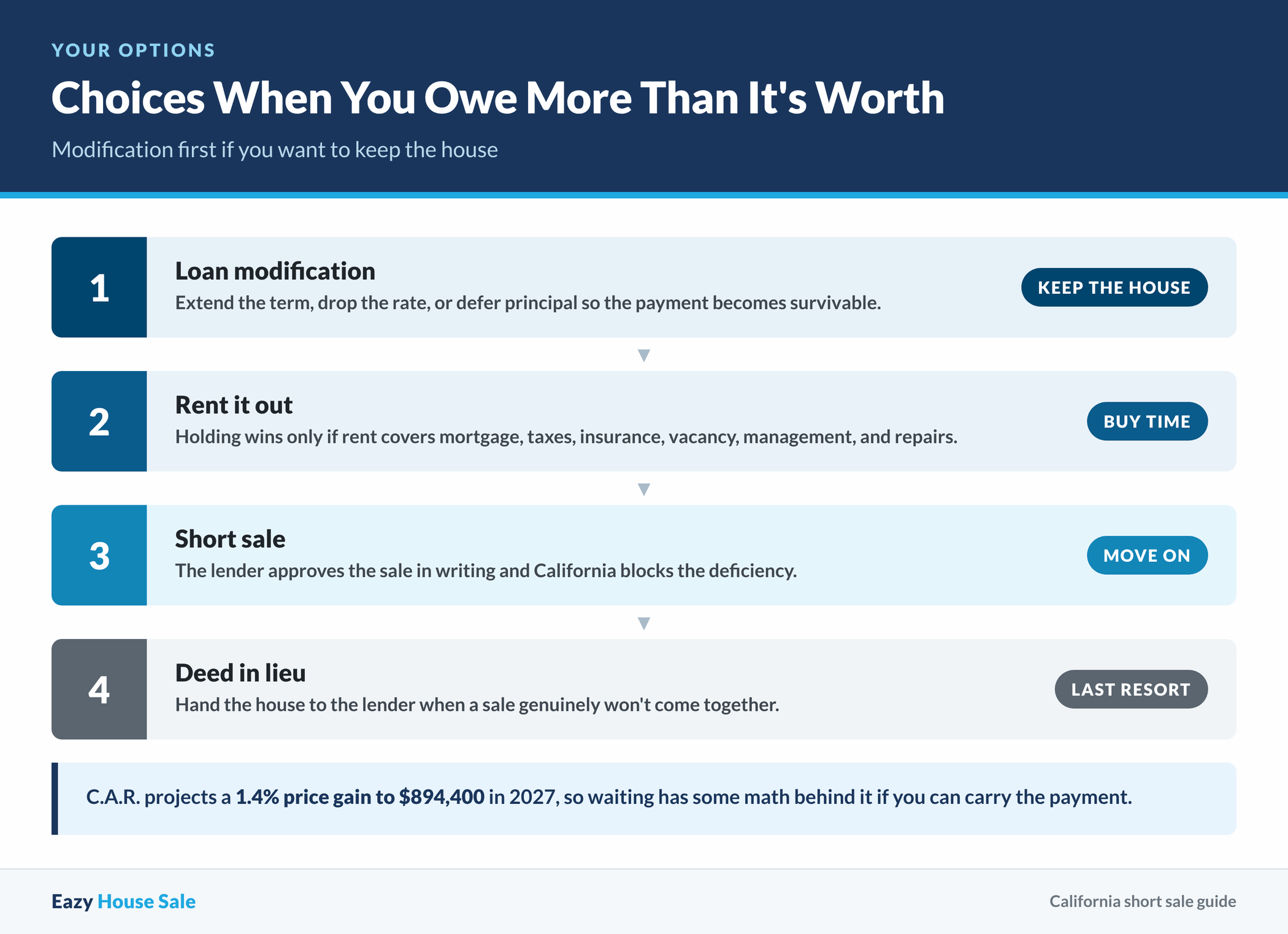
Loan modification is the real alternative worth pursuing first, and it’s usually worth a call to your servicer before anything else. Your servicer may extend the term, drop the rate, or defer a chunk of principal to the back end of the loan. Modifications don’t erase negative equity, but they can make the payment survivable while the California market works through its current slowdown. C.A.R.’s forecast released October 7, 2026 projects a 1.4% price gain to $894,400 in 2027, so patience has some math behind it if you can carry the payment.
Renting the place out is option two. Run the numbers coldly: mortgage, taxes, insurance, vacancy, management, repairs. If the rent covers all of it in your California submarket, holding beats selling for less than the balance. If you’re feeding the property three hundred a month, you’re buying time at a price.
A deed in lieu of foreclosure hands the house to the lender voluntarily. It’s cleaner than foreclosure and sometimes faster than a short sale, though lenders often require you to market the property first.
Bankruptcy belongs on the list but not in this article; that’s a conversation for a licensed attorney who can look at your full balance sheet.
My honest take? Modification first if you want to keep the house. Short sale if you don’t. Deed in lieu only when a sale genuinely won’t come together.
How Do You Sell a California House Quickly When You Owe More Than It’s Worth?
For years I told sellers that a short sale always takes four to six months, and that’s no longer true.
Lender timelines have tightened, and the biggest variable is now paperwork quality, not bank speed. A complete package moves. An incomplete one sits. You’ll want the hardship letter, two months of bank statements, recent pay stubs or profit-and-loss records, tax returns, a signed purchase contract, and a HUD-1 or estimated settlement statement. This shows the lender exactly what they net.
Buyer selection is where California sellers lose the most time. Retail buyers using financing walk away during long lender reviews, and then you restart with a new contract and a new approval. A cash buyer who’s done short sales before will sit through the wait. That’s the practical case for working with a direct buyer like Eazy House Sale when you need to sell for less than you owe without three rounds of failed escrows.
Price the property at genuine market value. Lenders order their own valuation, and an offer well under it gets rejected, costing you weeks. California’s sales-price-to-list-price ratio ran 98.5 percent in October 2026, which tells you buyers aren’t paying wild premiums anywhere in the state right now.
A landlord in Pittsburg called me on a Tuesday last spring, a week after moving his mother into assisted living in Walnut Creek. His duplex was underwater, the tenant had left a garage packed with paint cans and an old pool table, and he’d zero bandwidth for a listing. We took it as-is and worked the lender approval while he focused on his mom. That’s the version of this that goes well: one decision, one buyer, no open houses.
Frequently Asked Questions About Selling for Less Than You Owe in California
What Happens If Your House Sells for Less Than You Owe in California?
Your lender has to approve the shortfall in writing before escrow closes, and the sale proceeds go to them instead of to you. With that written approval on a one-to-four-unit California home, the state’s anti-deficiency statute described above blocks them from coming after you for the unpaid balance later. The forgiven amount may be reported to the IRS as income, so get a tax professional involved before you close.
Will I Owe Taxes If I Sell for Less Than My Mortgage Balance?
Possibly, and the answer changed for discharges happening now. The homeowner exclusion covered in the section above was tied to a cutoff date that has passed, so forgiven mortgage debt no longer gets that automatic shelter. Insolvency is the exclusion most California homeowners rely on instead: if your total debts exceeded your total assets right before the discharge, part or all of the canceled amount may stay off your return. A CPA can run that calculation in an hour.
Can My Lender Refuse to Let Me Sell for Less Than I Owe?
Yes. Lender consent is voluntary, and some servicers push for a loan modification or a deed in lieu instead. Your odds improve when you document a real hardship, submit a complete package the first time, and bring a buyer whose offer matches what the lender’s own valuation will show. Junior lienholders can also hold up the deal, so identify every recorded loan early.
How Long Does a Short Sale Take in California?
Plan on a couple of months from accepted offer to closing, though it stretches when a second lienholder or mortgage insurer has to sign off. That’s longer than a standard California sale, which is why financed buyers often bail partway through. Cash buyers who’ve handled underwater deals before are the ones who stay to the finish line.
Is It Better to Sell for Less Than I Owe or Let the House Go to Foreclosure?
A negotiated sale beats a trustee’s sale in almost every scenario I’ve seen in California. You control the timeline, you avoid having a foreclosure on your record, and the anti-deficiency protection attached to an approved short sale is written plainly into state law. Foreclosure also tends to leave the property in worse condition, which helps nobody.
Do I Need an Agent to Sell for Less Than I Owe?
Not necessarily. Agents who specialize in short sales earn their commission, and the lender typically pays it out of proceeds rather than you. But if your California home needs repairs you can’t fund, or you’ve already watched a listing sit without offers, going straight to a buyer who handles the lender negotiation themselves removes a layer.
If you’re underwater and trying to figure out the next move, I’m happy to look at your numbers with you. Tell me your payoff, your situation, and what you’d like to have happen, and I’ll tell you straight whether a sale makes sense or whether you’d be better off calling your servicer about a modification. No pressure, no obligation, and no hard feelings if you decide to wait.
Talk Through Your Numbers With Eazy House Sale
Owing more than your house is worth doesn’t have to leave you stuck. Contact Eazy House Sale with your payoff and your timeline, and we’ll tell you plainly whether a short sale, a modification, or a direct sale fits best. You can also fill out the form below to get a cash offer with no obligation.