
Five percent.
That’s the share of American homeowners who skipped an agent entirely over the past year, according to the National Association of Realtors’ 2026 Profile of Home Buyers and Sellers. Ninety-two percent of sellers worked with a real estate agent, and just five percent went the FSBO route, matching the all-time low. For a strategy that promises to put tens of thousands of dollars back in your pocket, that number should make you curious rather than scared. Selling by owner can work. What matters is whether it works for your house, your timeline, and your tolerance for phone calls at nine on a Sunday night.
I’ve bought houses from sellers who nailed the FSBO process and walked away thrilled, and I’ve also bought houses from sellers who spent four months trying and finally gave up. The difference almost never came down to intelligence.
Is Selling by Owner Worth It Compared to Using a Realtor?
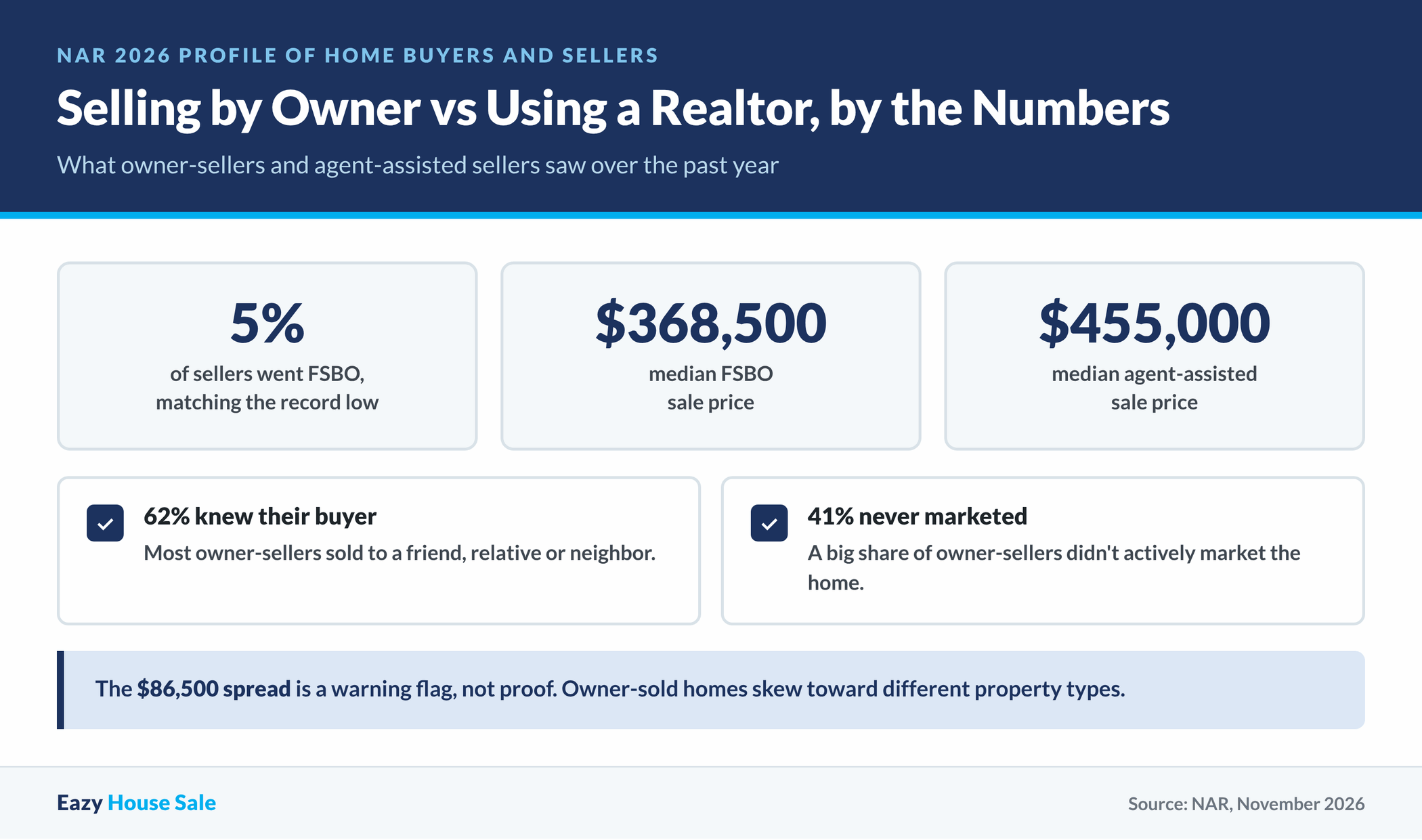
Usually it came down to the buyer pool. Sixty-two percent of owner-sellers in NAR’s 2026 survey already knew the person who bought their home: a friend, a relative, or a neighbor.
Without a buyer in hand, the math shifts. Forty-one percent of owner-sellers never actively marketed their home, and that single statistic explains most of the disappointing outcomes I hear about.
So is selling by owner worth it? For a seller with a motivated buyer already texting them, absolutely. Someone with a 1970s split-level and no idea how to reach buyers can watch the savings evaporate fast.
Sellers should weigh market conditions too. The median existing-home price hit $416,700 in October 2026, up 0.4% from a year earlier, and homes sat a median of 35 days on the market, up from 34 days the prior October. When buyers have options, a poorly presented house just sits there collecting price reductions, because nothing forces a buyer to settle when three similar listings sit down the street.
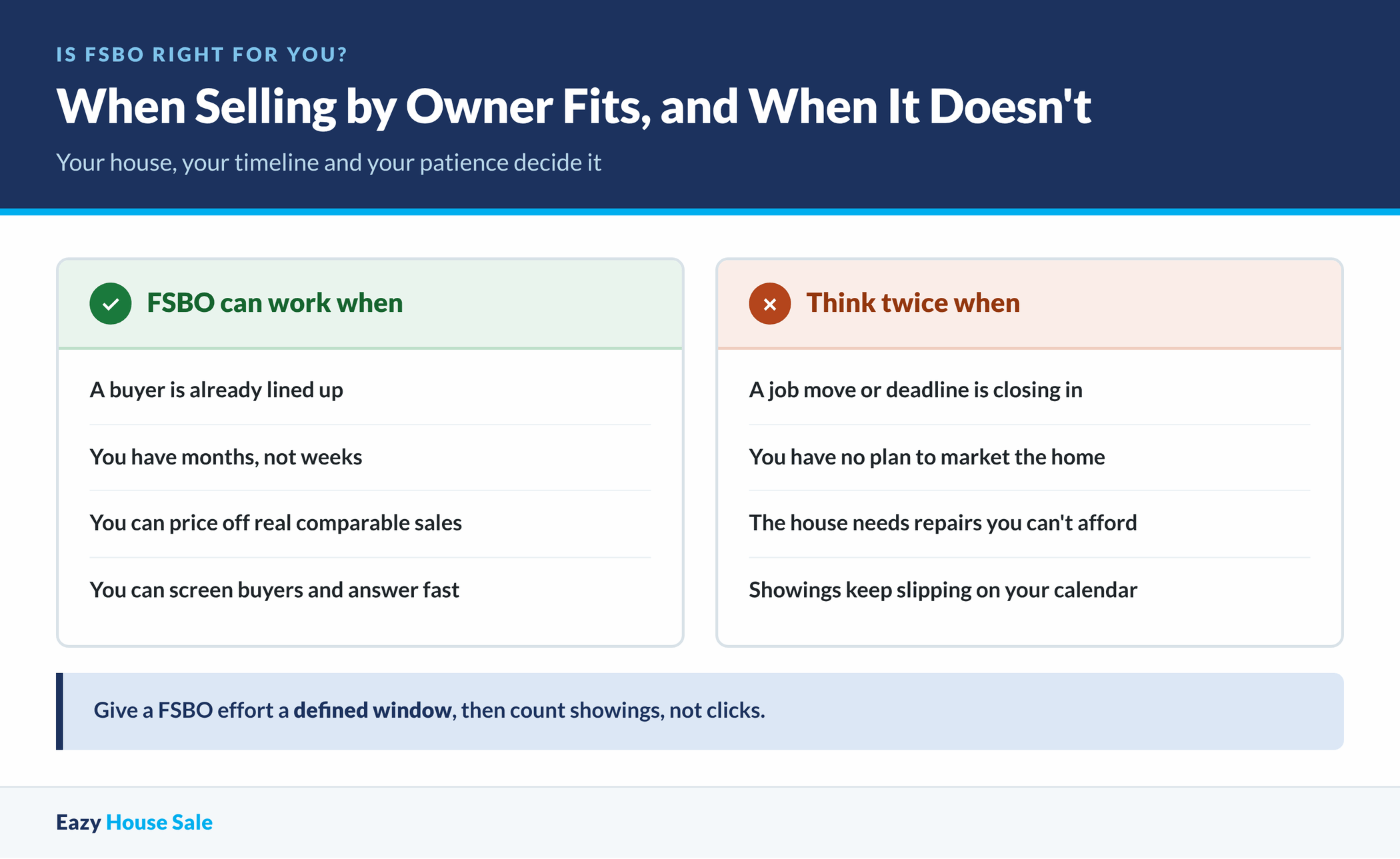
A young couple in Boise called me last year after a job transfer gave them five weeks to be across the country. They’d listed it themselves on a Saturday, got two lowball offers and a tire kicker who wanted to tour the detached garage three separate times, and realized the calendar was going to win. I’ve seen that same scramble play out with a dozen other sellers since.
If you’ve got six months and a weekend personality, selling by owner is a legitimate play.
How Big Is the Real Difference Between Realtor Commission and FSBO Savings?
A retired teacher I worked with had done the arithmetic on a napkin: six percent of her sale price, gone.
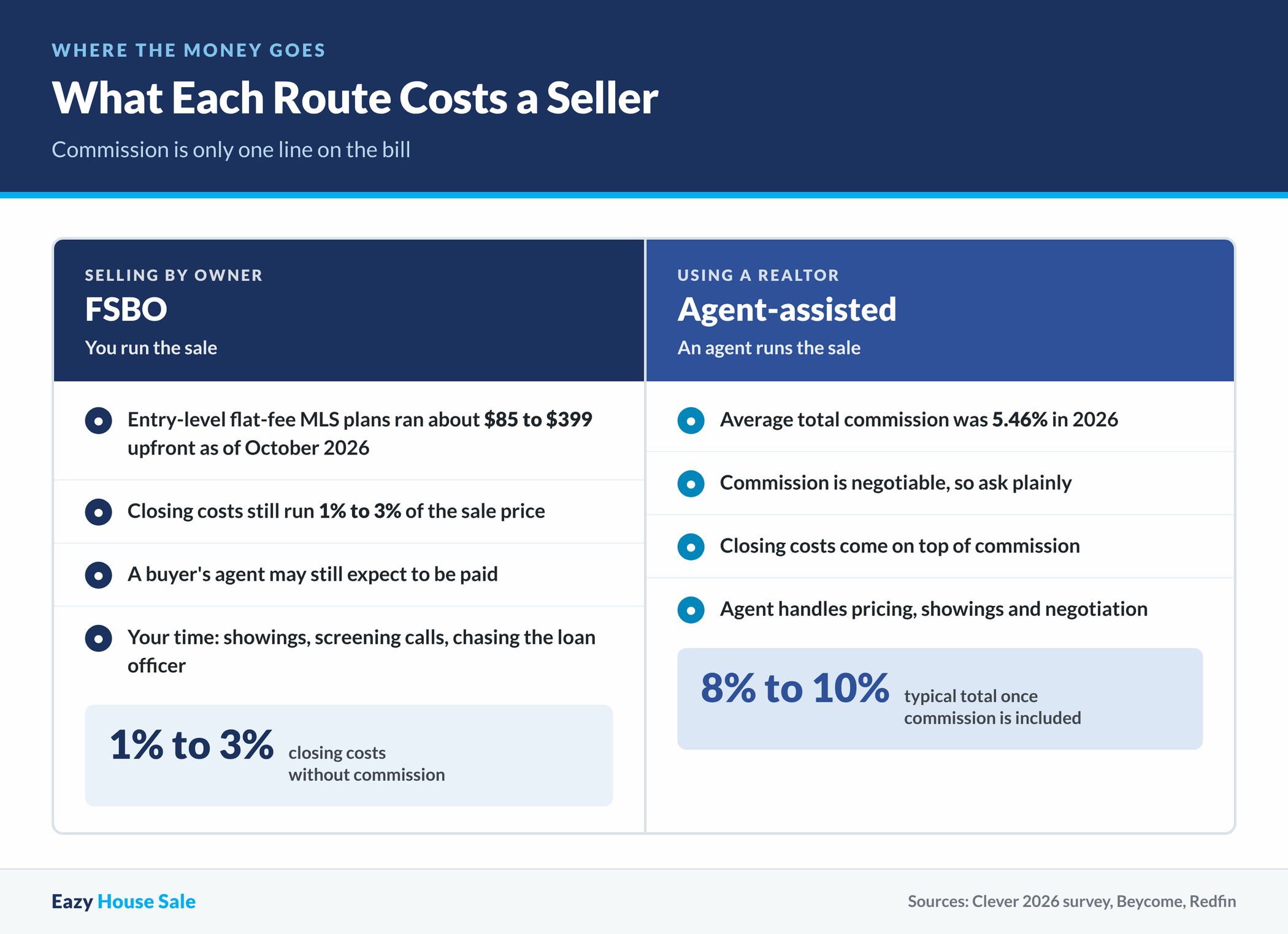
Six percent isn’t the real number anymore. The average real estate commission in 2026 sits at 5.46%, below the traditional 6% rate though higher than 2024’s floor of 5.32%. In one 2026 seller survey, only 16 percent paid six percent or more. Commissions have always been negotiable, and plenty of agents will come down if you ask plainly.
Now the uncomfortable part. Agent-assisted homes sold for a median of $455,000 over the past year, while owner-sold homes came in at a median of $368,500. That’s an $86,500 spread, far larger than any commission on a house in that range.
Owner-sold homes skew toward different property types and different situations, and NAR’s survey can’t fully separate those effects. I’d treat the spread as a warning flag rather than proof.
What I’d tell you instead: the commission you save is real and immediate, and the price you leave on the table is invisible. You’ll never see the offer that didn’t come because the right buyer never found your listing, which is the part FSBO sellers underestimate most. Selling by owner succeeds when you’ve closed that exposure gap on purpose, not by accident.
The commission question gets argued to death while the far bigger variable, how many qualified buyers physically walk through your door, barely gets discussed.
What Does for Sale by Owner Cost You?
Underestimate the non-commission costs and you’ll hand a buyer’s agent a check at closing and then wonder why your “free” sale cost five figures.
Strip the agent commission out and most sellers still pay 1% to 3% of the sale price in closing costs, which climbs back to roughly 8% to 10% once commission’s back in the picture. Transfer taxes in particular swing wildly between states, and your county recorder’s office can tell you exactly what your jurisdiction charges.
Then there’s the buyer’s agent. Most buyers still work with one. If that agent brings you a solid offer, you’ll probably be negotiating their compensation into the transaction, so half the commission savings often walks right back out the door.
A flat-fee MLS listing, professional photos, a lockbox, a yard sign, printed flyers, maybe a pre-listing inspection. Entry-level flat-fee MLS plans ran about $85 to $399 upfront as of October 2026, and that’s money worth spending.
Selling by owner costs time, too. Three weekends of showings, a dozen phone screenings, and the week you spend chasing a buyer’s loan officer all have value, even if no invoice ever shows up.
Sellers who want to skip the whole cost stack sometimes bring us in instead. Homeowners comparing routes often reach out to Eazy House Sale just to see what a direct offer nets them against a listed sale. Having a real number to compare against makes the FSBO decision far less abstract, and in my experience that single comparison is often what finally tips someone one way or the other.
How Do You Price Your Home Right When Selling by Owner?
Your asking price isn’t what you paid. Neither is an online estimate, and neither is what you need to clear to buy the next house.
Pricing is where selling by owner tends to go wrong most often. Half of owner-sellers price based on recent nearby sales, while others use an appraisal or lean on online valuation tools. That first group is doing it right, assuming they pick genuinely comparable homes: same square footage, same condition, same school boundary, sold in the last ninety days.
Pay for an appraisal. A few hundred dollars buys you a defensible number from someone with no stake in the outcome, and it gives you something to hand a skeptical buyer mid-negotiation.
Overpricing costs you real money in a market like this one. Redfin put median days on market at 50 days nationally in October 2026, with 4.3 months of supply. A house that launches too high burns through its best three weeks of attention, then needs a price cut that signals desperation to every agent watching.
Buyers don’t price your kitchen by what you spent. They price it against the other kitchens they toured that weekend.
Underpricing is the rarer error, but it happens when an owner just wants out. Three offers in forty-eight hours means you priced low, though that’s useful information because you can still negotiate up with competing bids.
Price with your eyes open and selling by owner has a real shot. Pricing on hope means you’ll spend the summer explaining to strangers why your house is worth more than the one down the street.
What Paperwork Do You Need to Sell a House by Owner?
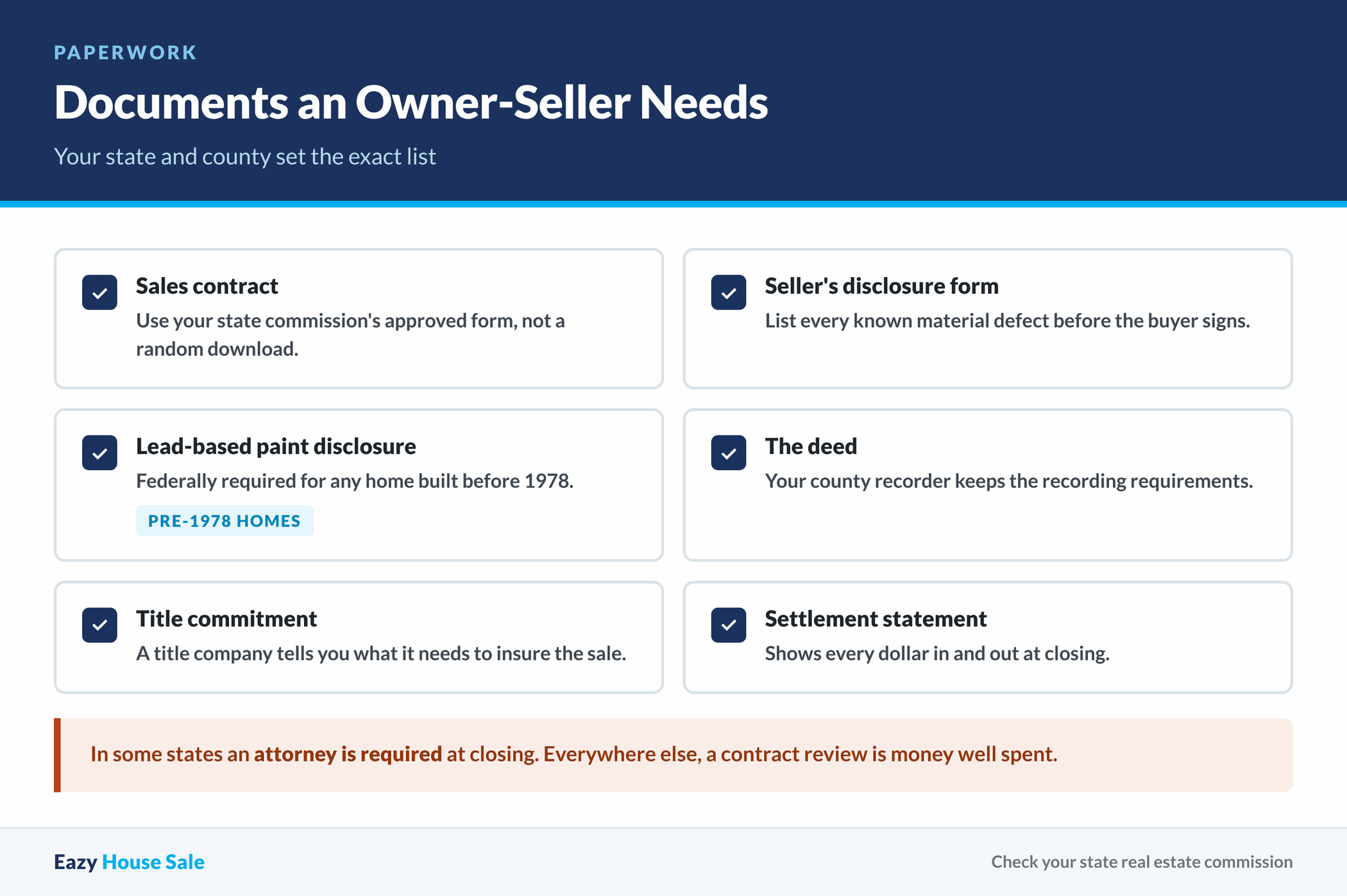
One form, federally required on any home built before 1978: the lead-based paint disclosure. Federal and state law both require sellers to make various disclosures, and actively concealing major physical defects is illegal in every state.
A sales contract, the deed, a seller’s disclosure form, a title commitment, the settlement statement, and any state-specific affidavits. Some states require a lien affidavit; others want a well and septic certification. Your county clerk or recorder’s office keeps the recording requirements, and a local title company will tell you what they need before they’ll insure the transaction.
Don’t download a generic sales contract from a random website. State real estate commissions publish approved forms, and many state Realtor associations sell theirs to the public for a modest fee, so you’re not stuck piecing one together yourself. In Pennsylvania, for example, the State Real Estate Commission promulgates the official property disclosure statement form.
I’ve watched two owner sales stall over an old mechanic’s lien nobody knew existed, and both took weeks to clear. Finding that at day three is annoying; finding it at day thirty-five costs you the buyer.
Will you need an attorney? In some states, yes, by law or by custom. Everywhere else, hiring one for a few hundred dollars to review your contract is the single best money you’ll spend when selling by owner.
Scan the disclosure form the day it’s executed.
What Do Disclosure Laws Require From an Owner Seller?
Plenty of sellers believe that an “as-is” sale wipes the slate clean. The sign goes up, the listing says as-is, and they figure that whatever the buyer finds later is the buyer’s problem.
In nearly every state, the duty to disclose known material facts applies whether or not the property is sold as-is. An as-is clause governs who pays for repairs, but it doesn’t give you permission to stay quiet about the basement that floods every spring.
What counts as material? Disclosure laws generally treat a material defect as a known condition that meaningfully affects the home’s value, health, or safety. Scuffed floors, faded paint, nail holes, and worn carpet are cosmetic, not material.
The forms and the timing differ state to state. Pennsylvania requires sellers to disclose known material defects before the agreement of sale is signed, and other states set their own forms and deadlines. Your state real estate commission publishes the form and the deadline that applies to you. Nolo keeps a plain-English overview of seller disclosure duties worth reading before you fill anything out.
Over-disclose. I mean it. The water heater you replaced, the roof repair from four years ago, the neighbor’s drainage complaint: write it all down. Disclosure liability is one of the genuine risks of selling by owner, since there’s no agent double-checking your form before it goes out.
Who Handles the Contract When There’s No Realtor Involved?
“If I’m not paying a listing agent, who’s going to make sure I don’t get taken advantage of?” Fair question. The answer is a real estate attorney or a title company, depending on your state.
In attorney-closing states, a lawyer handles the contract review, the title work, and the closing table. Title-company states hand that job to an escrow officer, who coordinates the paperwork, holds the earnest money, and issues the title policy.
Attorney review costs real money, but it saves more than it costs. For a few hundred to around fifteen hundred dollars, depending on your market, you get someone who reads the contingency language. They catch the closing date problem and explain what happens if the buyer’s financing dies in week three.
Should you negotiate directly with the buyer’s agent? You can, and plenty of owner-sellers do it well. Just know that the agent across the table does this fifty times a year and you’re doing it once.
A buyer’s agent who criticizes your kitchen is doing a job, not insulting your taste, and sellers who take it personally talk themselves out of good offers. Selling by owner means you’re your own buffer.
Earnest money never goes in your personal account. It sits with the escrow agent, the title company, or an attorney’s trust account, and any buyer who proposes otherwise should concern you.
Can You Handle Showings and Buyers Without a Realtor’s Help?
Before: a seller with a full-time job fielding texts at 7 a.m., driving home on lunch breaks to unlock the door. After: a lockbox, scheduled Saturday blocks, and a short pre-screening call that cut the tire kickers by half.
You make showings manageable the moment you stop treating every inquiry as urgent.
Screen for financing before you unlock anything. Ask for a pre-approval letter from a lender, not a pre-qualification text from a cousin. Nearly one-third of repeat buyers in NAR’s 2026 survey paid all cash, so proof of funds matters just as much as a lender letter.
Never show the house alone after dark, and tell someone when a stranger is scheduled to walk through.
A seller in Asheville reached out to me after her mother moved into assisted living in the spring. She’d tried selling by owner for six weeks. Between the weekend drives to visit her mom and a garage still packed with forty years of canning jars and Christmas decorations, the showings kept slipping. So staging a single room was never going to happen. We bought it as it stood, jars included.
When a seller is stretched thin, a direct sale through a buyer like Eazy House Sale removes the showing calendar altogether.
If you do push forward, respond to every inquiry within an hour during daylight. Buyers interpret slow responses as a seller who isn’t serious, and attention is the one asset you can’t buy back later.
Frequently Asked Questions About Selling by Owner vs Using a Realtor
Should I Just Use the Buyer’s Agent as My Agent Too?
Dual agency is legal in many states and banned outright in others, so start by checking your state’s rules. When one agent represents both sides, nobody is purely in your corner during the negotiation, and the agent’s duty to advocate gets split. If you’re set on selling by owner and a buyer arrives with an agent, I’d rather see you hire your own attorney for the contract than hand both roles to one person.
Will Buyers Lowball Me If They Know There’s No Agent Involved?
Some will try, because they assume you’ve saved the commission and expect you to share it. Your defense is documentation: a recent appraisal, a tight list of comparable sales, and a willingness to let a lowball offer sit unanswered for a day. Sellers who respond instantly to bad offers invite worse ones.
Can I List on the MLS Without Hiring a Full-Service Realtor?
Yes, through a flat-fee listing service that puts your property into the multiple listing service and onto the major portals for a one-time charge. You keep control of showings, negotiations, and the contract, and the exposure problem that sinks so many owner-sellers largely goes away. It’s the single highest-return decision in the whole process.
How Long Should I Try Selling by Owner Before Switching to an Agent?
Give yourself a defined window, something like thirty to forty-five days of genuine marketing effort, then evaluate honestly. Count the showings, not the clicks. If qualified buyers aren’t touring the property, the issue is price or exposure, and more patience won’t solve either one.
Does Selling by Owner Affect My Taxes Differently?
No. The capital gains rules work the same whether an agent was involved or not, and the federal exclusion for a primary residence depends on ownership and use, not on how you found your buyer. Commission you do pay reduces your taxable gain as a selling expense, so a lower commission can mean slightly more gain on paper. A CPA can run your specific numbers.
What If My House Needs Repairs I Can’t Afford?
You’ve got three honest paths: price the house to reflect its condition, offer a repair credit at closing, or sell directly to a buyer who buys as-is. Plenty of owner-sellers try to hide deferred maintenance and get caught at the inspection, which costs more than disclosing it upfront ever would.
If you want to talk through which route actually fits your house and your timeline, we’re here. No pressure, no obligation, and no hard feelings if you decide selling by owner is the right call and you just needed a second opinion to be sure.
Los Angeles Homeowners Have More Than Two Choices
Los Angeles County’s median single-family price was $955,090 in October 2026, according to the California Association of Realtors. At that price, every percentage point of commission is close to ten thousand dollars, so the route you pick matters.
If you’d rather skip both the listing and the showings, our team of cash home buyers in Los Angeles can give you a firm number to compare against.
We also buy houses as-is from homeowners in Long Beach and other nearby cities.
Talk Through Your Options With Us
Whether you list, sell on your own or sell direct, it helps to know every number first. Reach out to Eazy House Sale for a no-obligation cash offer, or fill out the short form below and we’ll get back to you.