
A letter from a trustee doesn’t mean the locks change tomorrow. It means a clock started, and that clock usually runs longer than you fear. California’s process still gives you real runway, and the people who get their house out of foreclosure are rarely the ones with the most money. They’re the ones who opened the envelope and counted the days.
What Is the California Foreclosure Timeline Homeowners Face?
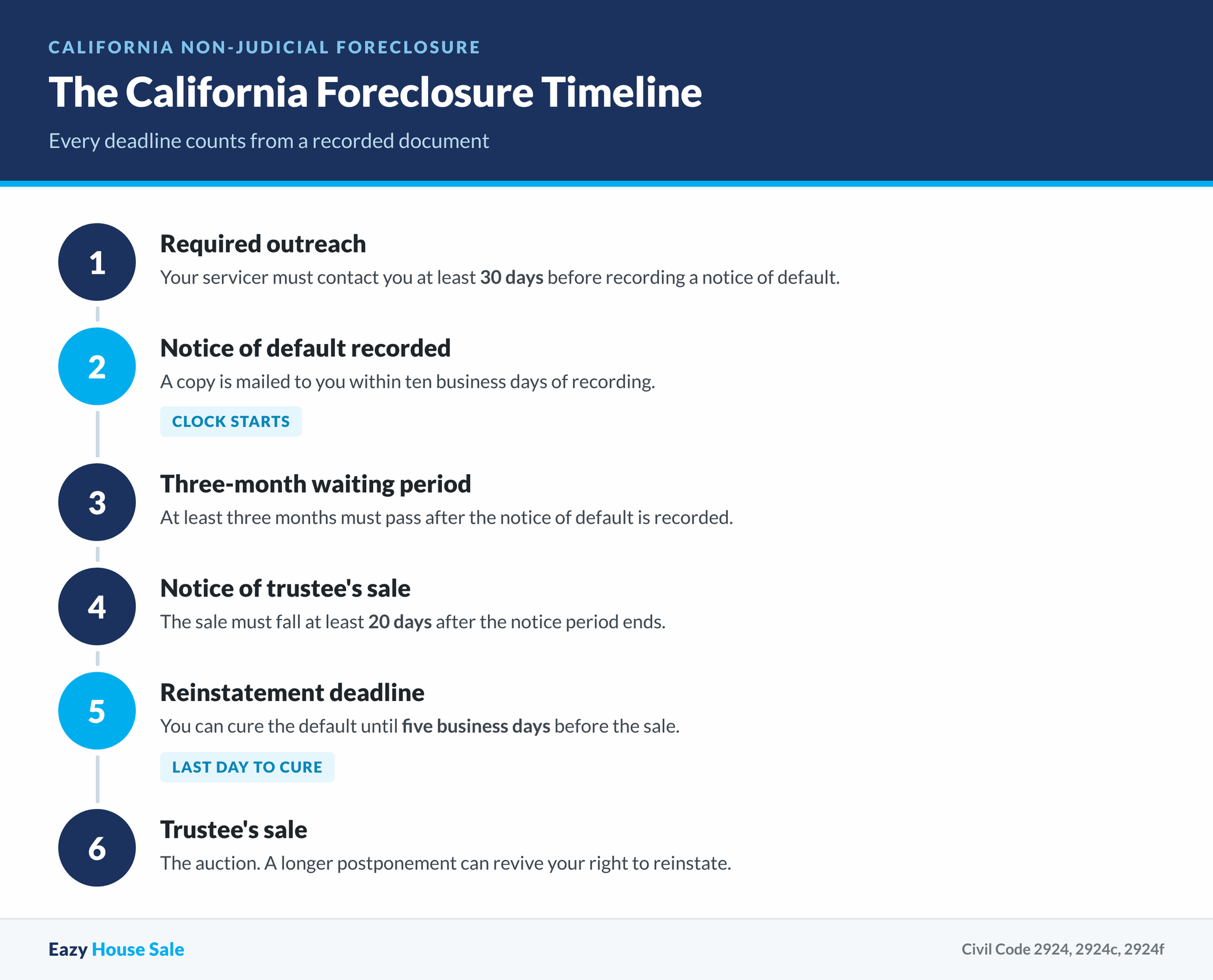
For years I told sellers they had ninety days after the notice of default, and that was wrong. Three calendar months is what the statute says, not ninety days, and those aren’t the same thing. Civil Code section 2924 requires three months to pass from the filing of the notice of default. Section 2924f adds at least 20 days of sale notice. Three months and 20 days is the statutory floor from notice of default to trustee’s sale. Depending on which month you’re in, that three-month stretch can run as short as eighty-nine days.
Before any of that starts, your servicer owes you a phone call. California requires the foreclosing lender or servicer to personally contact you, or satisfy the legal requirements for attempting contact, 30 days before recording a notice of default. That contact exists so someone can look at your finances and explore ways to avoid foreclosure, and Nolo’s summary of California foreclosure procedure walks through it.
So the real timeline for getting out of foreclosure in California runs longer than the scary version in your head. Thirty days of required outreach, then three months, then at least twenty more.
A retired couple in Bakersfield called me about a rental house in default. Their tenant had stopped paying, and the arrears stacked up on a loan they thought was nearly done. I still remember the husband telling me on a Tuesday that he’d rather eat the loss than spend one more Saturday hauling a broken dryer out of that garage.
Most California homeowners in default have real time to work with, and the number of them is smaller than the headlines suggest. ATTOM counted 21,543 California properties with foreclosure filings in the first half of 2026. Spread across nearly 14.6 million homes, that works out to one filing for every 680 housing units.
What Does Judicial vs. Non-Judicial Foreclosure Mean in California?
Plenty of homeowners brace for a courtroom, a judge, a summons with their name on it. Nearly every California mortgage includes a power-of-sale clause, and that clause lets the lender skip the courthouse entirely and go through a trustee instead. No judge signs off.
Non-judicial foreclosure is the default path in California for a reason: it’s faster and cheaper for the lender. Lenders in Los Angeles and Orange County take the trustee route almost without exception.
Here’s the trade you get in return. Reinstatement stays available until five business days before the sale, and a deficiency judgment is prohibited after a non-judicial foreclosure under Code of Civil Procedure Section 580d. If the auction brings less than you owe, the lender generally can’t chase you for the shortfall. Judicial foreclosure keeps that deficiency door open in some cases, which is one reason it’s rare.
It should motivate you more than it scares you. Non-judicial means no court will pause things on your behalf, so nobody’s going to notice your situation and intervene. Getting a house out of foreclosure in California is something you initiate, not something that happens to you.
Trustees follow the statute. Call yours, ask for the reinstatement figure in writing, and get the exact sale date from the recorded notice rather than from memory or a neighbor.
What Are the Steps of the California Foreclosure Process?
Those steps are more legible than they look, because each one is a recorded document with a date stamp on it. Missed payments come first, usually three or four of them. Your servicer sends breach letters.
The lender or trustee records the notice of default with the county recorder and mails you a copy within ten business days. This recording is the starting gun, so pull your copy and write the recording date on your refrigerator, because every other deadline in getting your California house out of foreclosure counts forward from it.
Then a notice of trustee’s sale goes up at the property and in a public place in the city where the sale will happen, inside that sale-notice window. The notice also runs in a newspaper once a week for three consecutive weeks and gets mailed to the borrower and other interested parties. Neighbors will see it too, which stings in a tight Sacramento cul-de-sac or a San Jose townhome row.
One thing I’d push back on: the common advice to “wait and see if the lender postpones.” Postponements happen constantly in California, and they lull people into doing nothing. I’ve watched homeowners lose three good months they could have used to get out of foreclosure, all because they assumed the next postponement was automatic.
How Do You Stop a Foreclosure Sale Before It Happens?
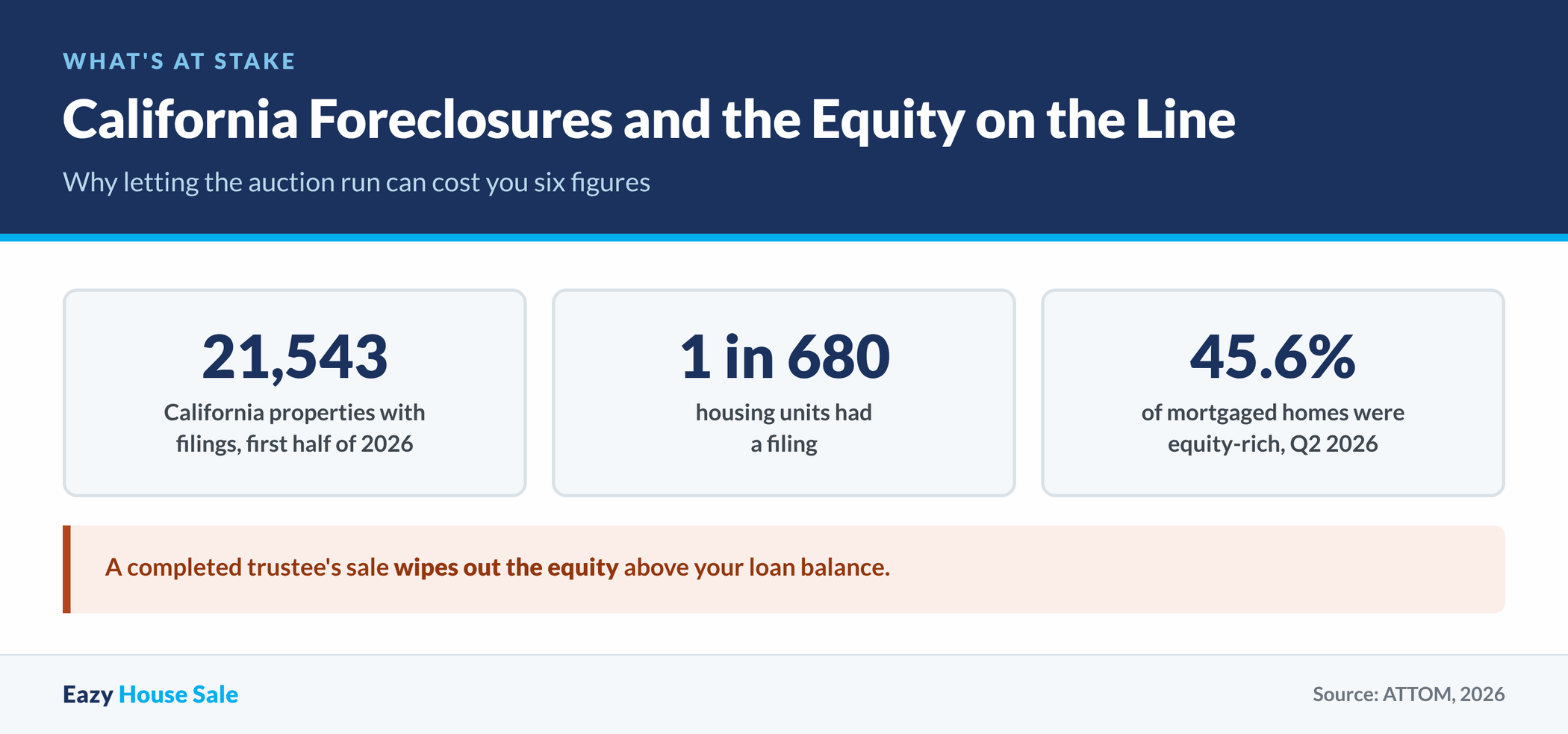
A completed trustee’s sale wipes out whatever equity sits above the loan balance, and California equity isn’t small. ATTOM found 45.6% of mortgaged California homes were equity-rich in the second quarter of 2026. Letting the auction run can mean handing a bidder six figures of your own money.
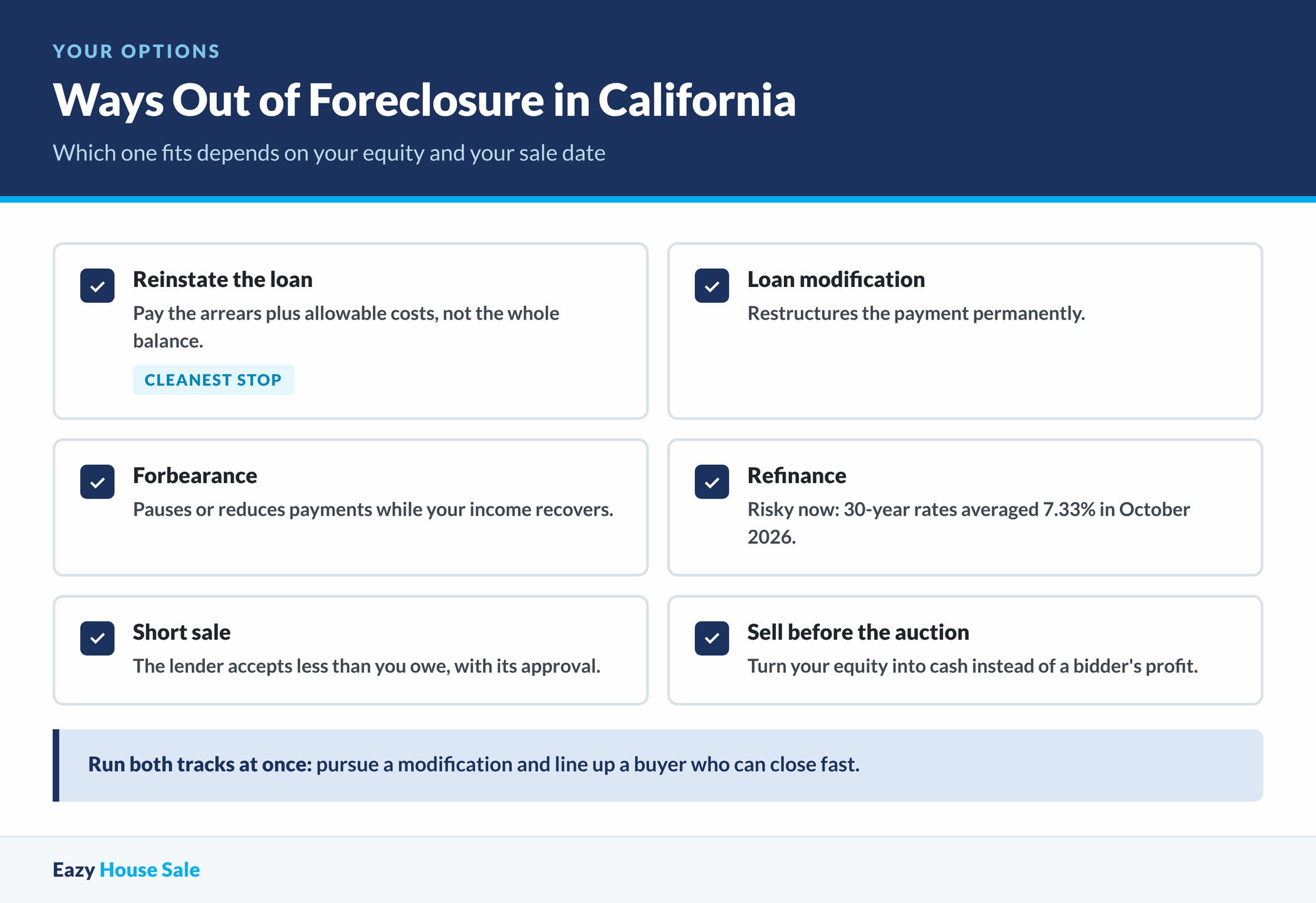
Reinstatement is the cleanest way out of foreclosure. California law lets you reinstate the loan by curing the default in a lump sum up until five business days before the trustee sale under Civil Code Section 2924c. You pay the arrears plus allowable costs rather than the whole balance, so the loan goes back to normal. Once you cure, the lender must execute and deliver a notice of rescission to the trustee within 21 days of the reinstatement.
Counting those five business days trips people up badly. Weekends aren’t business days, so counting back five business days from a Friday sale lands you on the previous Friday, which means your deadline sneaks up faster than it looks. Your practical deadline sits more than a week ahead of the auction date, not two days.
Postponement is a second lever. If the sale is postponed for more than five business days, the right of reinstatement comes back as of the postponement date. It then runs until five business days before the new sale date, as the text of Civil Code section 2924c spells out.
Filing a bankruptcy petition triggers an automatic stay that halts a California foreclosure sale, but that’s a decision for a bankruptcy attorney, not a blog post.
What Are Your Main Options to Get Out of Foreclosure?
Eight hundred eighty-six thousand, seven hundred sixty dollars. California’s statewide median home price in October 2026, per the California Association of Realtors, stood at that figure, down 1.4% from September and barely changed from a year earlier. That number matters because it tells you roughly what a California property is worth against the debt sitting on it. Your best path out of foreclosure depends on which side of that math you land on.
Loan modification restructures the payment permanently. Forbearance pauses or reduces payments temporarily, usually after a job loss or medical event, and it works best when your income is coming back.
Refinancing is the one I’d be most cautious about recommending right now. Average 30-year mortgage rates hit 7.33% in October 2026, up from 6.86% in September, according to the California Association of Realtors. Trading a 3% loan for a 7% one to cure a default can leave you right back here in eighteen months.
Any exit that needs the bank’s sign-off, like a short sale, takes time you may not have.
Selling outright is the option people resist longest and need most often. With real equity in the property, a sale before the auction converts that equity into cash in your pocket instead of a bidder’s. That’s where a direct buyer like Eazy House Sale fits, closing on a date that beats the trustee’s calendar without repairs, showings, or a sixty-day escrow.
How Do You Get a House Out of Foreclosure in California?
A homeowner in Riverside came to me eleven days out from a scheduled sale, convinced nothing could be done.
The sequence that gets a California house out of foreclosure is short. Start by pulling the recorded documents from your county recorder and confirming the sale date against the notice, not against what someone told you on the phone. Then request a written reinstatement quote and a written payoff quote from the trustee, since those two numbers define your whole decision.
Compare them against value. Most real estate brokers will run a comparative market analysis for free. In a market where homes sold in a median 29 days in October 2026, a traditional listing may still fit inside a three-month-and-twenty-day window if you move immediately. If your sale date is six weeks out, that math stops working.
Equity above the debt means you sell and keep the difference.
Where I see homeowners lose the most is delay disguised as hope. Waiting for a modification decision while the auction date closes in is the single most expensive mistake in California foreclosure. A denial at day eighty leaves you no runway, and I’ve watched that exact timeline sink homeowners who had other options. Run both tracks at once: pursue the modification, and have a buyer lined up who can close fast if the answer comes back no.
Deferred maintenance, a tenant still in place, a garage full of thirty years of accumulation; none of that stops a cash closing.
What Foreclosure Assistance Programs Does California Offer Homeowners?
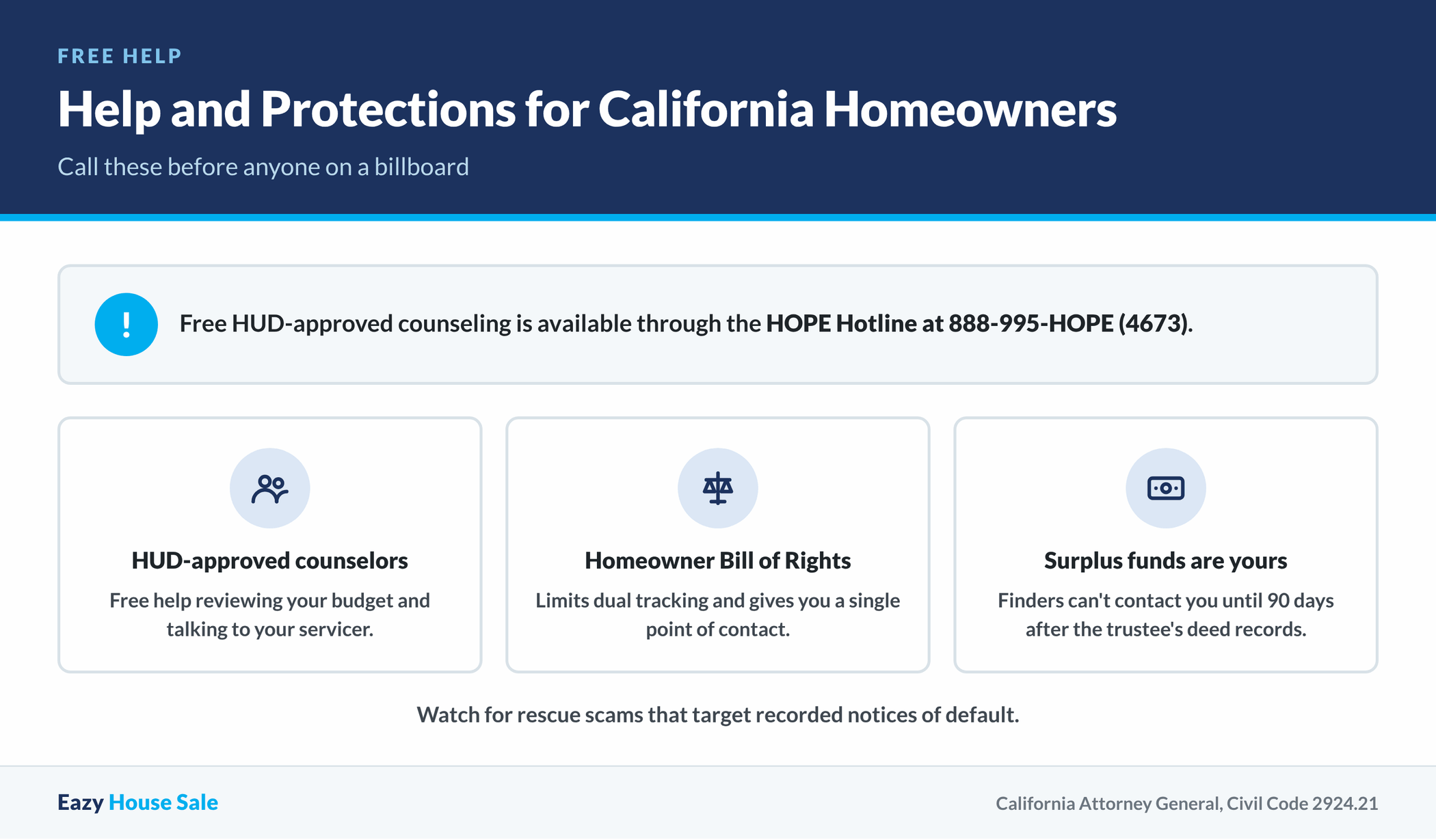
Call a free counselor before you call anybody who advertises on a billboard. The HOPE Hotline at 888-995-HOPE (4673), which California’s Attorney General points people to, connects you with HUD-approved housing counselors. That call is free. Nobody on that line is selling you anything.
Your servicer has to point you toward that same counseling. Under Civil Code 2923.5, the lender must give you HUD’s toll-free number for finding housing help during that pre-notice-of-default contact.
The Homeowner Bill of Rights gives California homeowners real teeth, and those rules can buy you time to work your way out of foreclosure. Its Civil Code sections cover dual-tracking prohibitions, a single point of contact requirement, and a private right of action for violations. Your servicer can’t push the foreclosure forward while a complete loss mitigation application sits under review.
Would you recognize a foreclosure rescue scam if one showed up? They cluster around recorded notices of default, because those recordings are public. The California Attorney General’s office publishes plain guidance on foreclosure scams, and it costs nothing to read.
One underrated protection: California prohibits companies from contacting or soliciting a foreclosed-upon homeowner about surplus funds until 90 days after the trustee’s deed is recorded. Surplus funds from a California foreclosure sale belong to you, and you don’t need to pay a finder to claim them.
Who Can Help You Get Out of Foreclosure in California?
“Who do I even call first?” That question comes up at nearly every kitchen table I sit at in California. My answer: whoever can tell you something true about your specific numbers.
Foreclosure attorneys are worth the money when the process has a defect, a servicer violation, or a bankruptcy question arises. HUD counselors handle that second scenario for free.
A real estate agent earns their keep when you have equity, time, and a property that shows well. Brokers who know your submarket can price it to move in weeks rather than months, and in parts of California that still works inside the foreclosure window.
Direct buyers fill the gap when time is the constraint. We’ve closed on California houses in under two weeks when the trustee’s calendar demanded it. Eazy House Sale works exactly this way for homeowners trying to get out of foreclosure with their equity intact.
A woman in Fullerton reached out while settling her father’s estate, right after moving her mother into assisted living two towns over. Her father’s house had a notice of default recorded against it and a 1970s kitchen nobody had touched. Its garage was stacked with her dad’s fishing gear and boxes of tax returns going back to the Carter administration. We took it as it sat, and she spent that month with her mother instead of a dumpster.
Frequently Asked Questions About Getting Out of Foreclosure in California
Can I Get Out of Foreclosure in California if I Owe More Than the House Is Worth?
Often, yes, through a short sale, where your lender agrees to accept less than the full balance so the sale can close. Expect to submit a hardship package and wait for written approval, so start early and keep the trustee’s date in view. A California real estate attorney can tell you how any remaining balance would be treated in your situation, and whether that route beats your other options.
How Far Behind Do You Have to Be Before a California Non-Judicial Foreclosure Starts?
Federal servicing rules generally keep a servicer from making the first foreclosure filing until your loan is more than 120 days delinquent. California layers its own contact requirement on top of that before any notice of default can be recorded. In practice, most California homeowners see a notice of default after three or four missed payments. The statutory clock described earlier in this article doesn’t begin until that document is actually recorded with your county.
What Happens to Tenants When a California Property Is Foreclosed?
Tenants don’t lose their housing the day the gavel drops. The federal Protecting Tenants at Foreclosure Act gives bona fide tenants a minimum written notice period before removal, and California generally honors the same window for occupants after a trustee’s sale. Tenants with a fixed-term lease often have the right to stay through the remainder of the term, and local rent ordinances in cities like Los Angeles and Oakland can add further protection.
Can a Deed in Lieu Get My California House Out of Foreclosure?
It can end the foreclosure, but you hand the house back to the bank instead of selling it, and any equity you’ve built goes with it. Many lenders want to see that you tried to sell first, and other liens on the title can block the request. If the house is worth more than you owe, a sale almost always leaves you better off than giving the deed back.
Does Listing My House Stop the Foreclosure Sale in California?
Listing by itself does nothing to the trustee’s calendar. The sale date stands until the loan is reinstated, paid off, or the lender agrees to postpone. What a pending sale can do is give your servicer a reason to grant a postponement, especially if you can show a signed sales contract with a close date ahead of the auction.
Can I Still Sell If I’ve Already Received a Notice of Trustee’s Sale?
Yes, and plenty of California homeowners do exactly that. A sale that closes and pays off the loan before the auction stops the foreclosure outright, and any proceeds above the debt and costs are yours. Speed is the only real constraint: you need a buyer who can fund without waiting on a lender’s underwriting department.
If you’re staring at a recorded notice and trying to figure out whether selling makes more sense than fighting for a modification, we’re glad to walk through the numbers with you. No pressure, no obligation, and no hard feelings if you decide to keep the house. Sometimes a twenty-minute conversation is all it takes to see which door is actually open.
Los Angeles Homeowners Facing a Trustee’s Sale
Los Angeles County’s median single-family price was $955,090 in October 2026, according to the California Association of Realtors. Equity like that is worth protecting before an auction date takes it.
Our team of cash home buyers in Los Angeles can close on a timeline that fits the trustee’s calendar.
We also buy houses from homeowners in the rest of California.
Get a Clear Number Before the Sale Date
If a notice of default or a sale date is sitting on your counter, a short conversation can show you which options are still open. Contact Eazy House Sale for a no-obligation cash offer, or fill out the form below and we’ll reach out.