
About two out of every three homes in this state carry a loan against them. So if you’re at the kitchen table wondering whether your balance stops you from selling, it doesn’t, and it never has. Owners sell a house with a mortgage every business day, from Eureka down to Chula Vista. I’ve bought plenty of them myself. The hard part isn’t permission. It’s knowing the order of payments at closing and what’s left for you once escrow wraps up.
Let’s take it one piece at a time, the way a neighbor would explain it over the fence.
Why a Mortgage Doesn’t Stop You From Selling in California
Few people explain this clearly, so sellers call their lender asking for permission they never needed. The deed of trust doesn’t freeze the property. It gives the lender a secured claim, and that claim gets paid out of the sale proceeds at closing. Selling a house with a mortgage in California is the normal transaction, not the exception.
Timing deserves more of your attention than the loan balance. Homes listed in California sat a median of 57 days on the market in October 2026, according to Realtor.com data tracked by FRED. Tack escrow onto that and you’re looking at about three months from signing to funding. Slower inland pockets can run longer.
Not long ago I worked with an out-of-state heir whose mother had just moved into assisted living in Whittier. She flew in on a Thursday. The garage held forty years of canning jars and a 1980s Buick that hadn’t started since the Clinton administration. Running a listing from three time zones away wasn’t realistic. Her mom still owed on the loan, and she figured that would block everything. It didn’t.
The one thing you can’t do is sell a house with a mortgage in California and pocket the sale money without paying the lender. Escrow takes care of that on its own. If that’s where you are and you’d like a straight read on your numbers, Eazy House Sale will go over the payoff math with you without pushing you toward a sale.
What Happens to Your Mortgage When You Sell Your House?
Think of a California closing day as a short, dull ceremony where three checks go out in a set order.
The buyer’s money goes to the escrow company first. Escrow sends the payoff amount straight to your mortgage lender. It then settles property taxes and recording costs, pays real estate agent commissions if you used one, and wires what’s left to you. Nobody hands you a lump sum and trusts you to square up with the bank.
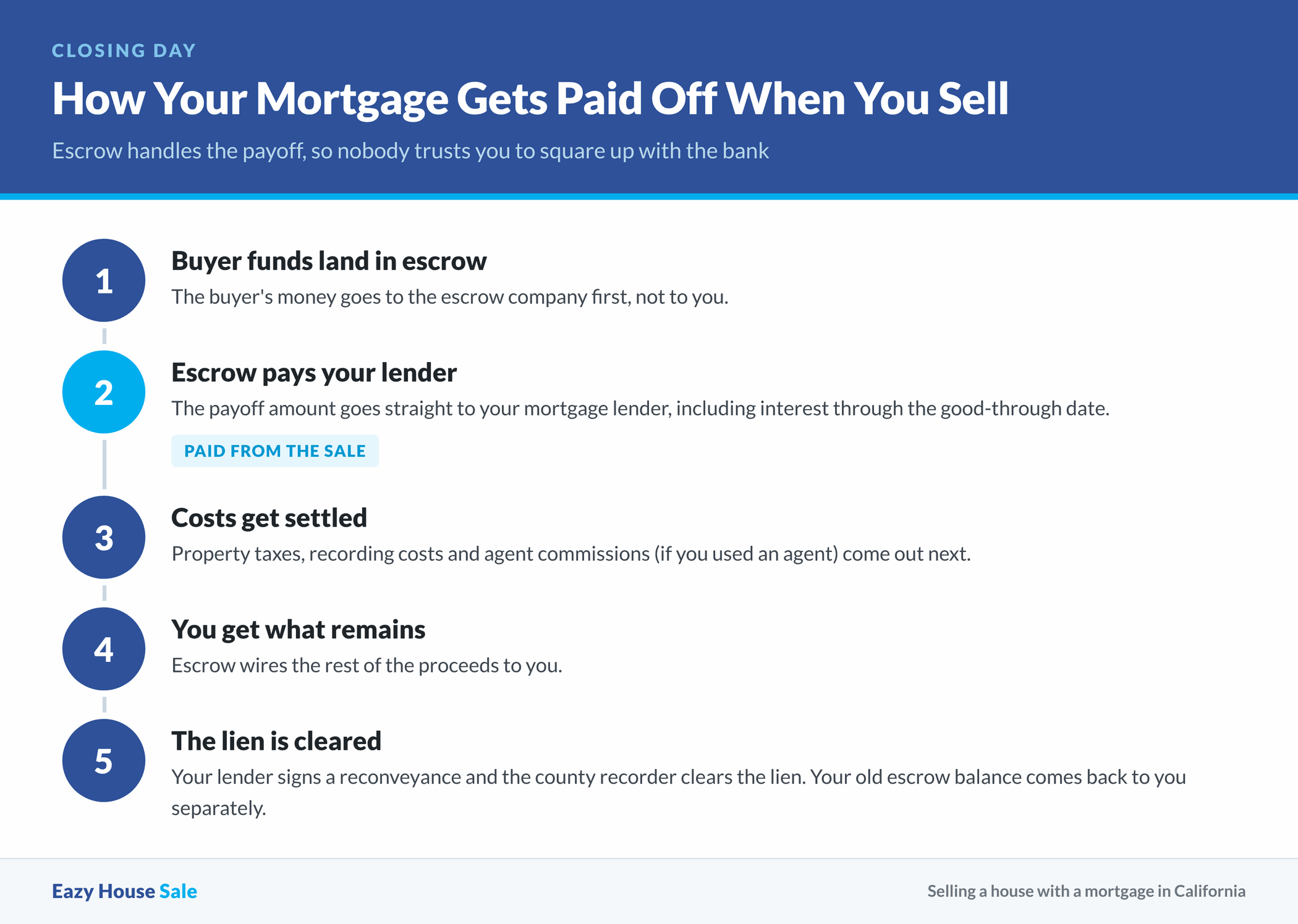
Your loan doesn’t follow you to your next house, and it doesn’t hang around waiting on anything. Your lender signs a reconveyance and the county recorder clears the lien. Then the title company issues title insurance confirming the buyer owns the property free of your old debt.
Escrow accounts confuse a lot of people at this stage. The cushion your servicer collected for property taxes and insurance is your money. Federal rules require the servicer to return your escrow balance after the loan is paid off. Watch your mail for that refund instead of assuming it disappeared into the payoff.
Sellers often forget they still owe the regular monthly payment while the house sits in escrow. If closing slips three weeks, that payment comes due anyway. Miss it and your credit takes a hit right when you’re trying to qualify for the next loan. Pay it. Any overpayment comes back to you in the payoff reconciliation.
Assumptions deserve a quick mention too. FHA and VA loans can sometimes be taken over by a qualified buyer, which keeps the old interest rate alive. Conventional mortgages almost never allow it. Their due-on-sale clause lets the lender demand full repayment the moment title transfers in California.
Do You Have to Pay Off Your Mortgage Before Selling in California?
No. Anyone telling you to pay it down first is steering you wrong.
Paying down principal from savings before you list does nothing for your net proceeds. The same dollars leave either way. You’ve just moved cash from your bank account into the payoff wire a few months early, and you’ve drained the reserve you’ll need for the move.
The payoff comes out of the sale itself. Picture your loan balance as a line subtracted from the sale price, since nobody expects you to clear it first.
Some situations do call for cash upfront. If you’re behind and the lender has already recorded a notice of default, catching up the arrears can buy breathing room. That gives you time to market a house with a mortgage in California while interest keeps building and nothing has closed yet. That step is called reinstatement, and the math differs from a payoff.
This is where I’d push back on the usual advice. Agents across California often urge sellers with thin equity to spend five or ten thousand on cosmetic updates in hopes of a higher price. The equity-rich share of California mortgaged homes fell from 56.9 percent in Q2 2025 to roughly 45.6 percent in Q2 2026, per ATTOM’s second-quarter report. Plenty of owners can’t afford that gamble. Spending borrowed money and hoping to earn it back is a bet, and I wouldn’t call it a plan.
Ask yourself one question. If the updates don’t lift your price, can you still close? If the answer feels shaky, sell as-is.
How Do You Pay Off Your Mortgage After Selling Your House in California?
For years I assumed the payoff figure matched the balance on the monthly statement. It doesn’t, and that gap has surprised more than one seller at the table.
A payoff statement covers the remaining principal plus interest through a specific good-through date. It also includes any fees the servicer is allowed to charge. Your monthly statement is a snapshot. The payoff quote is tied to a calendar date and keeps moving. If that date passes, escrow has to request an updated figure.
By law, your lender has to send an accurate payoff statement within seven business days of a written request. The rule sits in 12 CFR 1026.36, and the CFPB sums it up in its borrower rights handout. Your title company usually requests it for you, though you may need to sign an authorization first.
A California closing pays things off in a fixed order. Escrow collects the buyer’s funds and then clears liens by priority. Unpaid property taxes come first, since California law puts them ahead of every other lien. After that, the first mortgage usually gets paid, followed by any HELOC, second mortgage, or judgment lien.
Sellers with a HELOC they haven’t touched in years need to close the line, not just pay it to zero. An open line can be drawn on again. Title won’t clear until the lender agrees in writing to close and release it.
These delays are easy to prevent. Request your payoff early and confirm the servicer has the right escrow contact. Don’t let selling a house with a mortgage in California stall over a fax nobody sent. I’ve watched closings slide a week over exactly that.
What Happens to Your Home Equity When You Sell with a Mortgage?
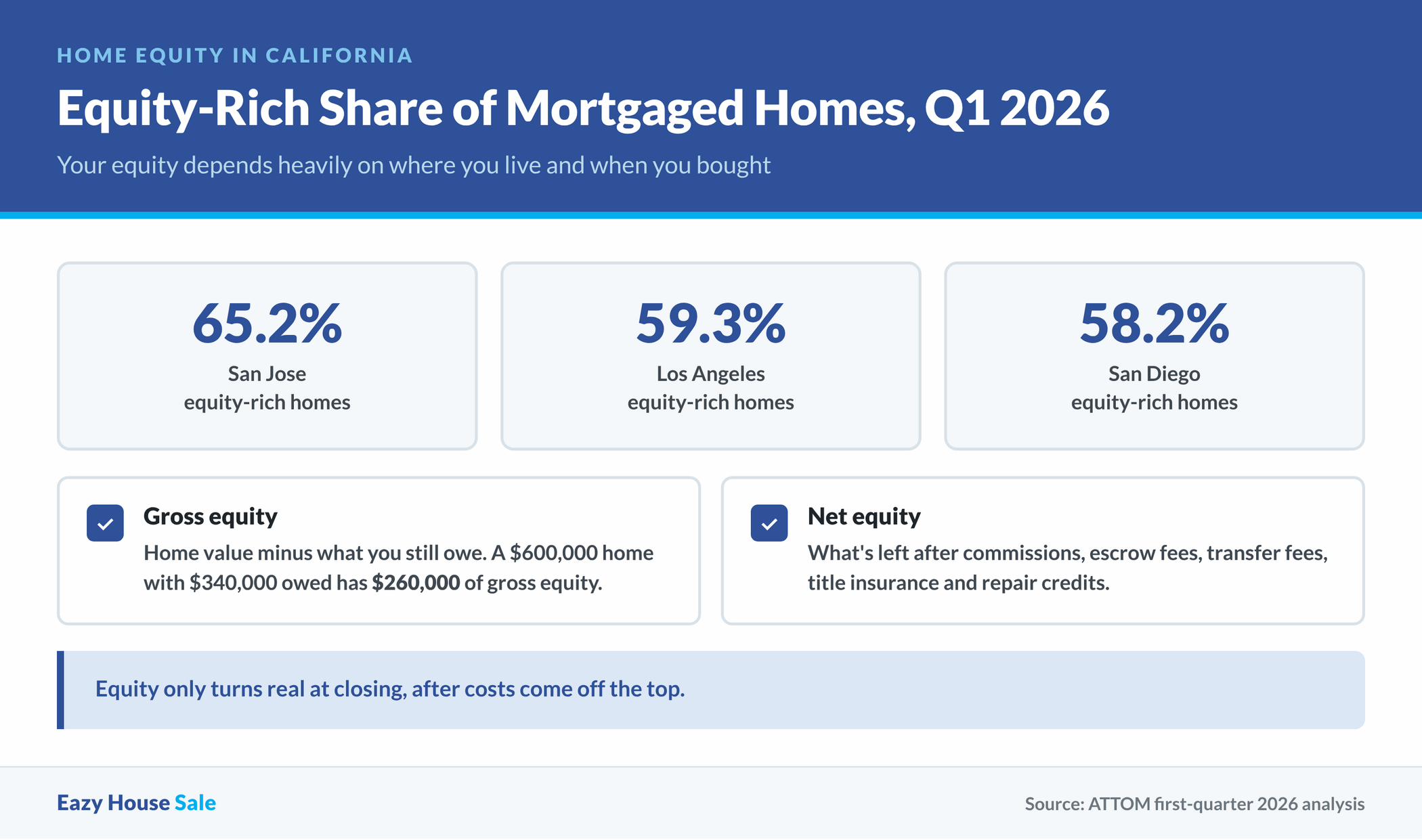
Take a Riverside-area home worth $600,000 with $340,000 still owed. Your gross equity is $260,000. Your net figure is smaller, and that difference is where people get let down.
Equity isn’t money in the bank. It’s an estimate that only turns real at closing, after costs come out. Commissions, escrow fees, county transfer fees, title insurance, and any repair credits you agreed to all come off the top before your wire arrives.
Your California equity swings a lot by region, so don’t measure yourself against a cousin’s sale. San Jose led the nation at 65.2 percent equity-rich homes in Q1 2026, with Los Angeles at 59.3 percent and San Diego at 58.2 percent, according to ATTOM’s first-quarter analysis. Owners in parts of the Inland Empire and the northern Central Valley are in a very different spot.
Two California neighbors with identical houses can sell and walk away with very different checks. It mostly comes down to how long each one has held the loan. Someone eleven years into a 30-year note has paid down real principal. A 2022 buyer who put little down has barely dented it.
A softer market eats into equity too. The statewide median list price in California dropped 2.9 percent year over year to $719,000 in October 2026, per the same Realtor.com series. Small declines hit recent buyers the hardest.
When your equity is thin, selling a house with a mortgage in California to a direct buyer can keep more of it in your pocket than a traditional listing would. You skip commissions and repair demands entirely.
How Much Money Do You Keep When You Sell a House with a Mortgage?
Guess wrong on this number and you could show up at closing owing money instead of collecting it. I’ve seen sellers plan a down payment on their next place around a figure that was never going to happen.
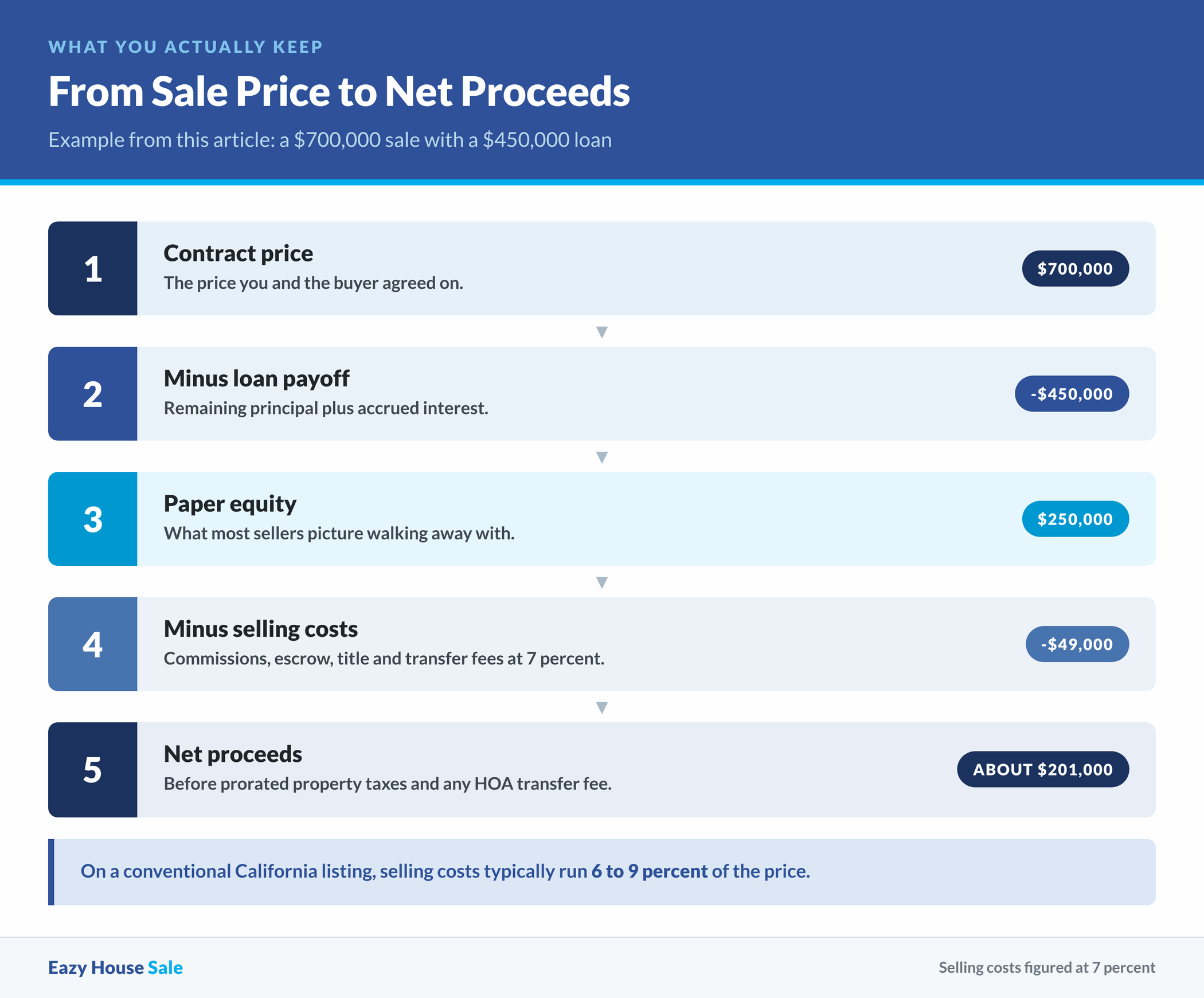
Start with the contract price. Take out the payoff. Subtract selling costs next. On a conventional California listing, they usually run somewhere between 6 and 9 percent of the price. That covers agent commissions, escrow and title charges, and county documentary transfer fees. It also covers the credits buyers ask for after inspection.
Run the math on a $700,000 sale with a $450,000 loan. Costs at 7 percent come to $49,000, so your net proceeds land near $201,000 instead of the $250,000 of paper equity. Property taxes get prorated on top of that, and any HOA transfer fee comes out as well.
Federal tax rules usually work in your favor here. The IRS lets eligible homeowners exclude up to $250,000 of gain on a main home, or up to $500,000 for married couples filing jointly. You’ll need to meet the ownership, residence, and look-back tests in IRS Topic 701. Rental conversions and short ownership periods make it messier, so check with a CPA before you count on it.
Selling direct changes the cost side. You pay no commissions and skip staging and inspection credits, and you get to pick the closing date. The tradeoff is price, and any honest buyer will tell you that upfront.
So which matters more to you, a higher number on paper or a firm date when your obligation ends?
What If Your House Sells for Less Than Your Mortgage Balance?
Most people assume equity grows every year they own a home. That holds right up until you refinanced in 2022, pulled cash out for a remodel, and watched values flatten. Nationally, 3.2 percent of mortgaged homes were seriously underwater in Q2 2026, owing at least 125 percent of market value, per first tuesday’s analysis of the ATTOM data.
Negative equity still has a way out. In California, a short sale means your lender agrees to take less than the full balance and release the lien so the sale can close. It’s slower than a standard sale, often by sixty to ninety days. The bank’s loss-mitigation team has to sign off on the price and your hardship paperwork.
You’ll want to confirm one thing in writing: whether the lender waives the deficiency or keeps the right to chase it. California has anti-deficiency protections that apply in certain situations, and they don’t cover every loan or every seller. A real estate attorney can tell you where your note falls.
If the shortfall is small and temporary, ask about forbearance.
A cash sale sometimes closes the gap without a short sale at all, especially when the seller can bring modest funds to the table. Companies like Eazy House Sale look at underwater files in California all the time and tell owners plainly when the numbers don’t work.
Doing nothing costs the most. A foreclosure stays on your credit far longer than a negotiated short sale, and it takes away whatever control you had over timing.
What Mistakes Should You Avoid When Selling a House with a Mortgage?
“Can I just stop paying once it’s under contract?”
I hear that question constantly, and the answer is no. Contracts fall apart, and financing can die in underwriting. Until escrow funds, that loan is yours, and a 30-day late mark stays on your report for seven years.
Second mistake: ignoring liens you forgot about. Think old contractor liens, state tax liens, or a solar loan recorded against the property. Title turns up every one, and each has to clear before a house with a mortgage in California can transfer.
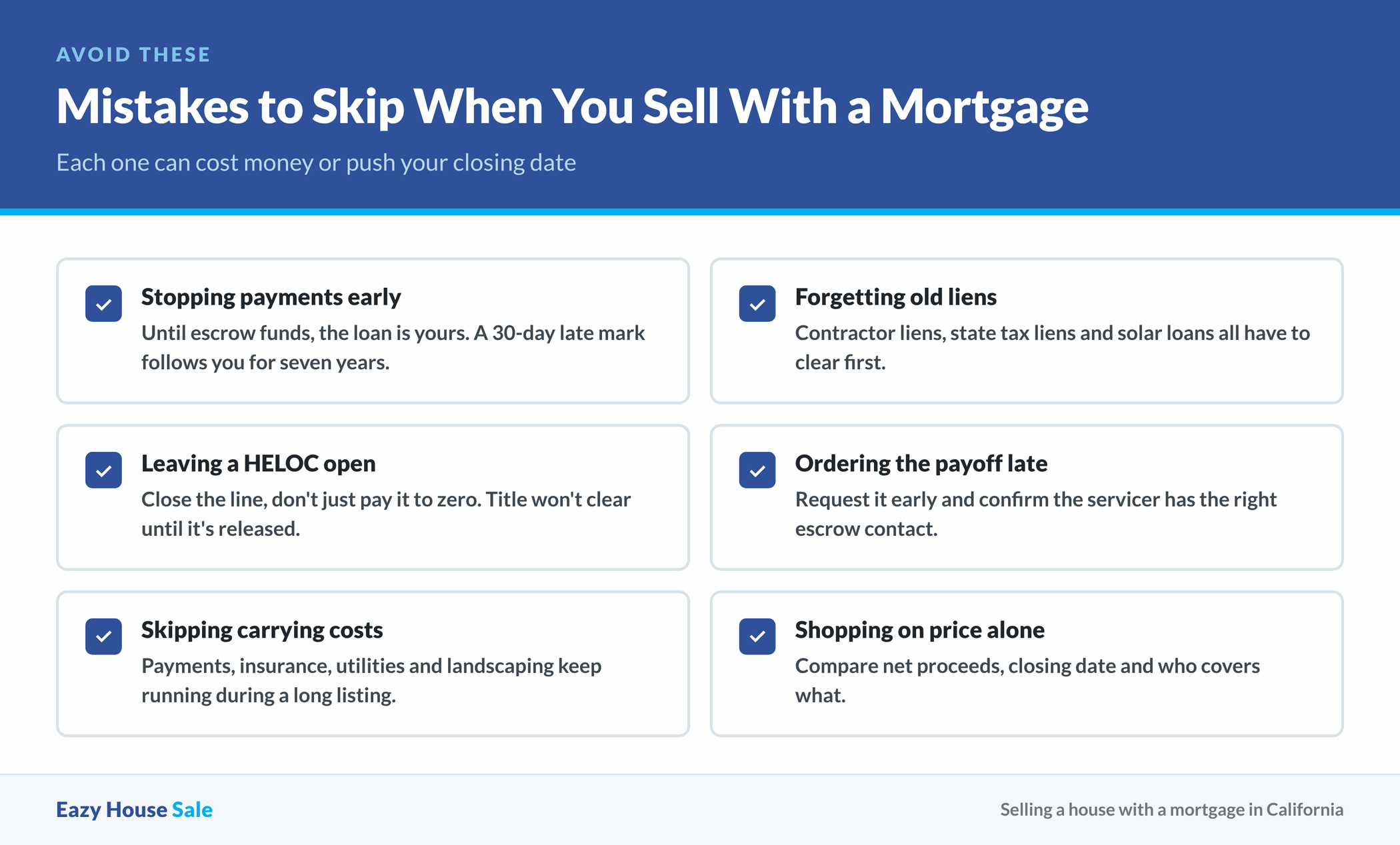
Third, California sellers lowball what a long listing costs to carry. Payments, insurance, utilities, and yard care keep running while you wait. At current California market times, that’s two or three months of bills most people never budget for.
A seller in Rancho Cucamonga once called me after taking a job in Austin with five weeks to be out. His listing had been live six weeks with two price drops. In the garage sat his kids’ bikes and a workbench bolted to the wall. His loan payment was due in nine days. We closed before his start date, and he didn’t have to repaint a thing.
Last one: shopping on price alone. Compare net proceeds, closing date, and who covers what. A slightly lower offer that closes on schedule often beats a higher one that falls apart in week four.
Frequently Asked Questions
Can I Sell a House with a Mortgage in California If I’m Behind on Payments?
Yes. Falling behind doesn’t take away your right to sell, and many owners sell for that exact reason, to stop the losses before foreclosure proceedings advance. Your lender gets paid from the proceeds, including any arrears and late fees, and escrow builds those into the payoff figure. Act quickly, since your window shrinks fast once a trustee’s sale date is set.
Does My Mortgage Lender Have to Approve the Sale?
Not for a normal California sale where the proceeds cover the full balance. Your lender just sends a payoff quote and releases the lien once the money arrives. Approval only comes into play when you’re asking the bank to take less than it’s owed, which is the short sale process covered above.
Can the Buyer Take Over My Existing Loan Instead?
Only if your note allows it. Government-backed loans sometimes let a qualified buyer assume them. Most conventional notes, though, include a clause that lets the lender call the balance due when the property changes hands. Call your servicer and ask whether your loan is assumable before you advertise it that way.
Will I Owe Taxes on the Money I Walk Away With?
Possibly, though the federal exclusion mentioned earlier fully shields most primary-residence sellers in California. What counts is your gain, meaning the sale price minus your original cost plus improvements. The size of the check escrow wires you doesn’t decide it. A seller with a big loan balance and a small gain often owes nothing.
How Fast Can I Close If I Sell a House with a Mortgage in California to a Direct Buyer?
Two to three weeks is realistic once your servicer sends back the payoff statement, since there’s no buyer financing to underwrite and no appraisal contingency. Title work usually sets the pace, more than the loan does. If you need a certain date for a move or a new job, say so early and the closing can usually be built around it.
What If My Mortgage Has a Prepayment Penalty?
Most California home loans written in the last decade don’t carry one, but older notes and some non-qualified mortgages do. If a penalty exists, it shows up as a line item on your payoff statement. It won’t be a surprise at the table. Request that statement early so you know the real number before you accept an offer.
If you’re weighing your options on a house with a mortgage in California and want someone to run the actual numbers with you, we’re happy to help. There’s no pressure or obligation, and we won’t push if selling turns out to be the wrong move for you. Sometimes the best thing a conversation does is show you’ve got more room than you thought.
Selling a House With a Mortgage in Los Angeles
Los Angeles County’s median single-family price was $994,670 in September 2026, up 1.2 percent from a year earlier, according to C.A.R. That’s a lot of value riding on one payoff figure.
Owners who bought years ago often sell and walk away with a healthy check. Recent buyers, and anyone who refinanced in 2022, may find the margin much thinner. Eazy House Sale buys houses across Los Angeles County, including from homeowners in Long Beach.
We also work with sellers in Pasadena and across California who’d rather skip a long listing.
Talk Through Your Mortgage Payoff With Eazy House Sale
You don’t need every number worked out before you call. Tell us roughly what you owe and when you’d like to move. We’ll show you how a cash offer compares with listing, and you can decide from there.
Reach out to Eazy House Sale whenever you’re ready, or fill out the short form below this post.