
A three-bedroom house in Fresno and a three-bedroom house in Palo Alto take the same legal paperwork. One of them runs up roughly four times the fee bill. That’s the oddest part of probate cost in California. The bill follows the price tag of the property, not the hours anyone worked. So a family inheriting a modest ranch house in a neighborhood that got pricey around it ends up paying as if it inherited a mansion. If you’re sorting out a parent’s estate and trying to guess what probate cost will land on you, there’s a set formula. That predictability cuts both ways.
How Much Does Probate Cost in California?
The number you’re after starts with gross value, and gross means before the mortgage. An heir with a Sacramento house carrying a big loan still pays fees figured on the full appraised amount. That comes as a shock the first time you run the math. California bases fees on gross estate value, debt included, instead of net value. That’s part of why probate here costs more than almost anywhere else.
I use a simple frame with sellers. Add up the statutory attorney and executor compensation. Then stack court filings, the appraiser’s commission, publication, and maybe a bond on top. One estate planning firm puts total probate cost on a $1 million estate at $61,000 to $81,000, with the case running 12 to 18 months. That’s real money leaving a California family.
Home prices explain why so many families end up here. The California Association of Realtors reported a statewide median existing single-family home price of $899,720 in September 2026. That was down slightly from August and up 1.7 percent year over year. One median California house clears most simplified-procedure limits on its own, which is why so many ordinary estates land in full probate court.
Early last year I looked at a duplex in Vallejo owned by a longtime landlord who’d held it since the eighties. His contractor’s kitchen estimate came in above what the new kitchen would add to the property value. He’d been sitting on that bid for months while the probate case ticked along. We bought it as it stood, avocado tile and all.
Probate cost in California isn’t one bill. It’s six or seven, and they show up at different moments. That’s why the total surprises people who only budgeted for a lawyer.
How Are California Probate Attorney Fees Calculated?
The schedule is a ceiling, not a floor. An agreement to pay the attorney more than the statute allows is void under Probate Code section 10813, and section 10803 does the same for the executor. Attorneys can also agree to take less. Almost nobody asks.
Under Probate Code section 10810, ordinary attorney fees run 4 percent on the first $100,000 and 3 percent on the next $100,000. The rate then drops to 2 percent on the next $800,000 and 1 percent on the next $9 million. It falls to 0.5 percent on the next $15 million. Above $25 million, the court sets a reasonable amount. You can read the statute and the governing sections in the California Legislative Information database, though most families get the number faster from a probate attorney’s calculator.
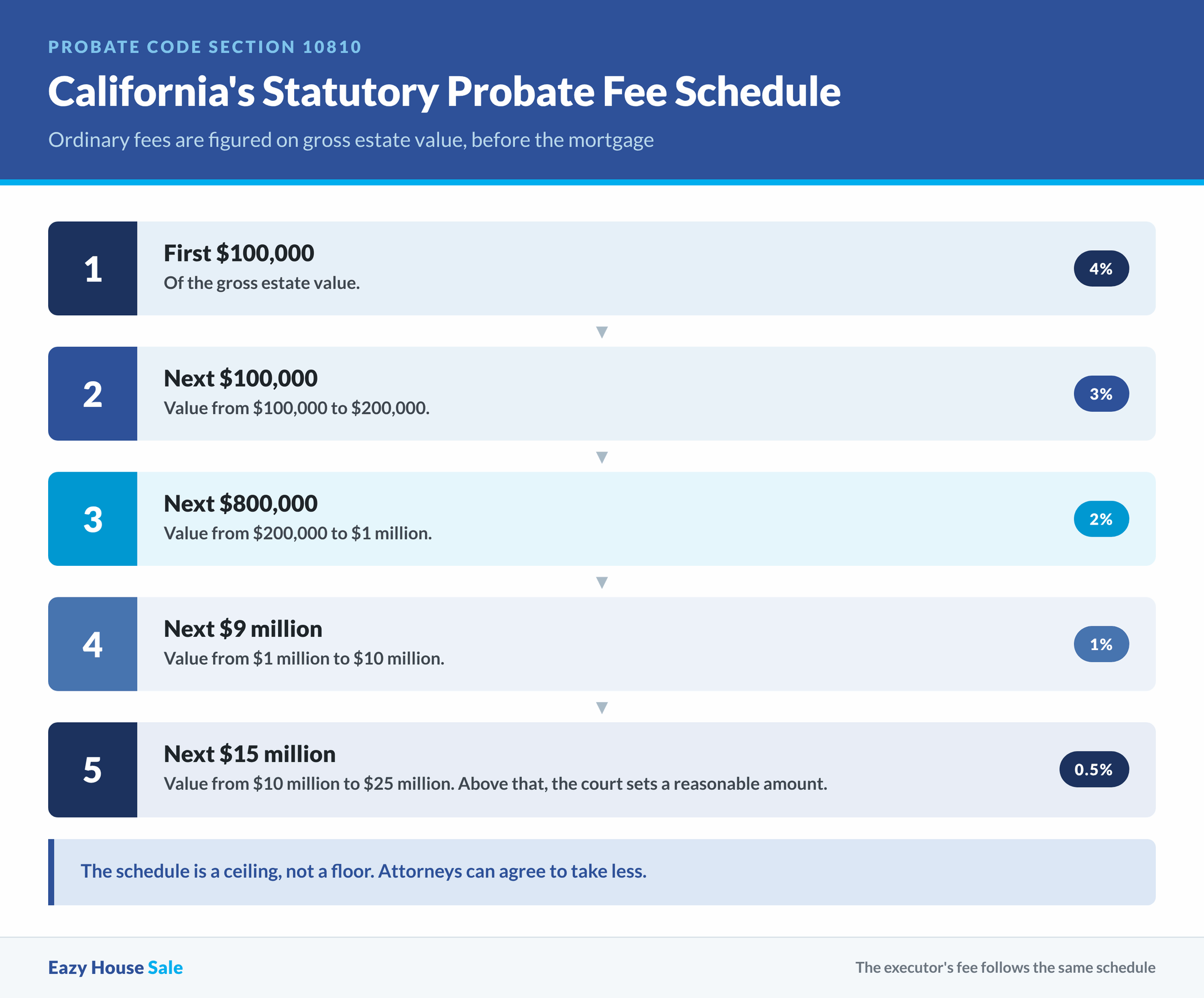
Notice that the percentage applies no matter how routine the case is. The schedule covers ordinary services in a standard probate regardless of the hours the attorney actually puts in. A clean California estate with one house, one bank account, and two agreeable heirs pays the same rate as a messy one.
Extraordinary fees are the probate cost nobody budgets for. Probate Code section 10811 allows extra attorney compensation on top of the schedule for unusual services, and section 10801 does the same for the executor. Selling real estate, fighting a will contest, or handling a business interest can all qualify. The court approves the amount.
Does that strike you as fair? My take is that the statutory system is honest about being arbitrary, and I prefer that to hourly billing you can’t forecast. Still, the probate cost on a California estate tends to track the housing market more than the legal work.
What Does an Executor Get Paid in a California Probate Case?
Plenty of adult children take the executor job thinking it’s volunteer work, something you do because Mom named you. Then they learn the Probate Code sets their compensation at exactly the same rate as the attorney’s. Section 10800 governs ordinary compensation for the personal representative, and section 10810 governs compensation for the attorney.
The two fees are figured separately, so the estate effectively pays the schedule twice. On a $1 million California estate, that’s $23,000 for the attorney and $23,000 for the executor, or $46,000 in ordinary statutory compensation. The doubling catches families off guard, since most online summaries mention only the lawyer.
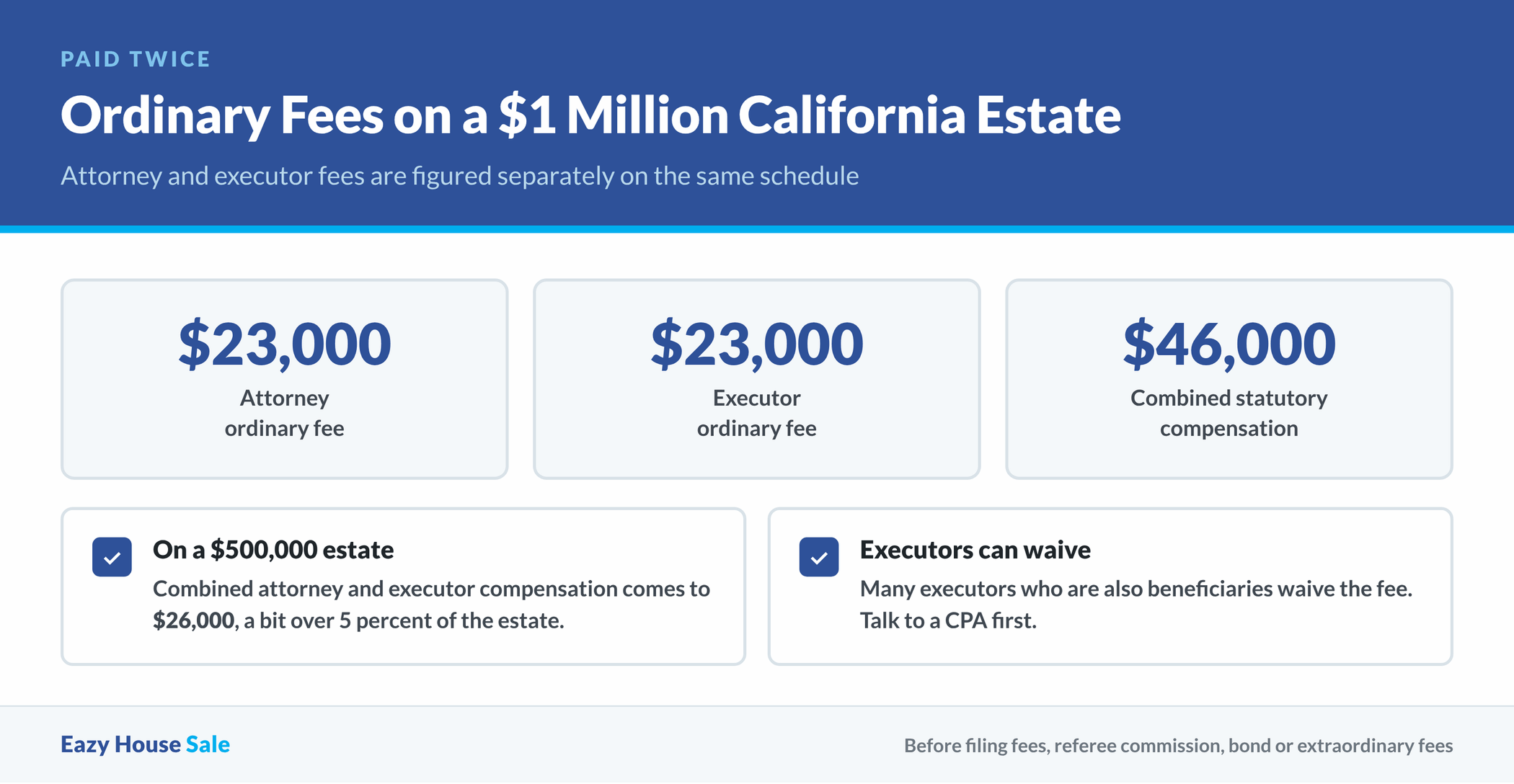
An executor can waive the fee. Many do, especially when they’re also a beneficiary, since inherited money generally arrives in better tax shape than earned compensation. Talk to a CPA before you decide, because the math shifts with the size of your share.
The job is real work, too. You’re insuring a vacant California house, paying utilities, mowing the yard, taking calls from the referee, and filing an accounting with the court. Out-of-pocket expenses like postage, travel, property upkeep, and insurance premiums get repaid from the estate when you keep receipts.
Keep a notebook from day one. I’ve watched executors lose hundreds in fair reimbursements because they paid cash for a roof tarp and never wrote it down. Probate cost comes out of everyone’s inheritance, yours included, and sloppy records quietly push it higher.
What Court Fees and Filing Costs Should You Expect?
You might figure the court itself is the cheap part of probate cost. You’d be right, though not as right as you’d hope. Under Government Code section 70650 and two statewide surcharges, the probate petition filing fee comes to $435, and a second $435 applies to the petition for final distribution. That’s two bites, roughly a year apart.
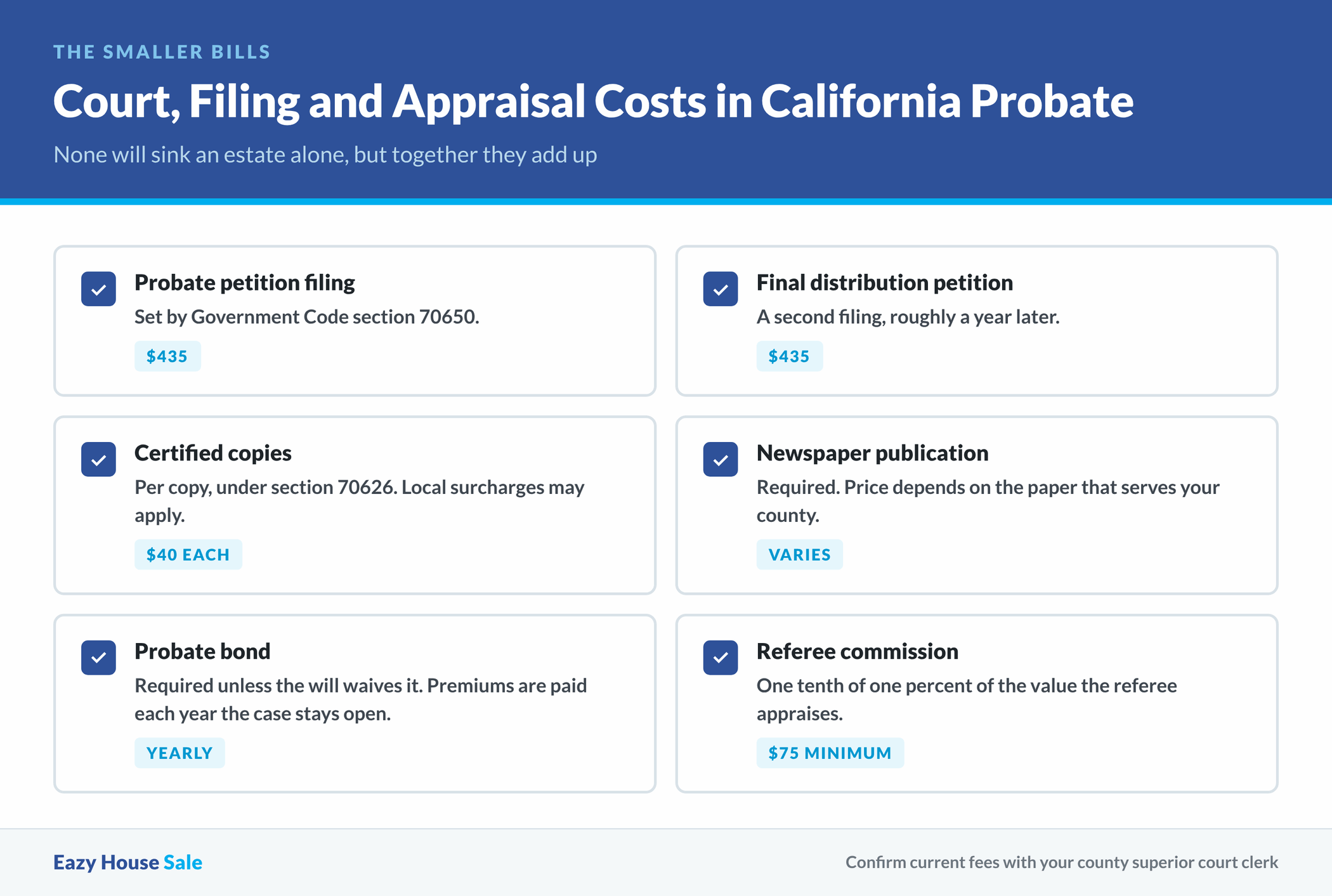
Smaller charges pile up beyond the filings. A certified copy runs $40 under Government Code section 70626, and some California counties add local surcharges. You also have to publish notice in a newspaper of general circulation, and the price depends on which paper serves your area. A San Mateo County publication bill won’t match a Kern County one. Your county superior court clerk can confirm the current filing fee and the approved papers.
Bond is the sleeper expense. If the will doesn’t waive it, or there’s no will at all, the court can require the executor to post a bond sized to the estate. Put bond premiums on the probate cost list next to the filing fees, referee commission, publication, and certified copies. Premiums are due every year the case stays open, so a California probate that drags into a second year pays twice.
The California Courts self-help site walks through the forms if you’d like to see the paperwork before you commit.
None of these line items will sink an estate alone. Together they add a few thousand dollars of probate cost that trickles in a bit at a time, which is exactly how it slips past the family budget.
How Do Probate Referee Fees Affect Property Value?
One tenth of one percent. Probate Code section 8961 sets the referee’s commission at that rate on the value of the property the referee appraises. Section 8963 caps it at a fixed maximum per estate, with a $75 minimum. The California State Controller appoints the referee, and the court assigns one to value non-cash assets as of the date of death.
A referee appraising a $700,000 Bakersfield rental earns $700. That’s cheap next to the rest of the probate cost. The appraised number does double duty, though, because it feeds the gross value that drives the attorney and executor schedules. A high appraisal costs the estate far more in statutory fees than in referee commission.
The personal representative can value cash and cash-like accounts on their own. Real estate, vehicles, business interests, and securities go to the referee on the Inventory and Appraisal forms.
Sellers ask me whether they can push back on a referee’s figure that seems too high. You can raise it with the attorney, and proof helps: deferred maintenance, a failed sewer lateral, or a foundation issue in an older California bungalow. A referee working from comps alone may not know the kitchen hasn’t been touched since Carter was president.
A softer market can actually help you on valuation. California showed 74,992 active listings and a median 57 days on market in October 2026, with inventory up 6.2 percent from a year earlier. In a slower California market, comps for a property that truly needs work are easier to defend. That trims probate cost at the source.
What Drives Up Probate Costs for Executors?
Vacancy is what gets you. Forget the lawyer and the court for a second. It’s the twelve months of a California house sitting empty, with insurance, utilities, yard care, and property taxes running while the case crawls toward final distribution.
Disagreement among heirs is the second driver of probate cost, and it’s the pricey one. Litigation adds hourly billing of roughly $300 to $800 per hour on top of the statutory fees. Two siblings fighting over whether to keep or sell the family home in Pasadena can burn more in a quarter than the whole ordinary fee schedule.
Repairs come third. Sellers often sink money into a property they plan to unload, convinced the estate will get it back at sale. Sometimes that’s true. Often it isn’t, especially on dated systems where the work costs more than the bump it adds to the appraisal.
More than one property multiplies everything: more referee appraisals, more insurance, more upkeep, and more chances for a leak when nobody’s living there. A California estate with a house in Riverside and a cabin near Tahoe isn’t twice the probate cost. It’s more.
What’s your honest timeline for getting this resolved? If the answer is “whenever my brother stops arguing,” the carrying costs alone deserve a line in your math. Plenty of families in this spot ask Eazy House Sale for a straight as-is number early. They just want to know what the property would bring without six months of contractors and staging.
Probate cost grows with time. Every month the case stays open, something else gets added.
How Do Probate Costs Affect What Beneficiaries Receive?
For years I told heirs the fees were a percentage, so the share would stay about flat across estates of different sizes. I was wrong in a way that matters. The schedule charges higher rates on the first chunks of value, so a smaller California estate loses a bigger share of itself to probate cost than a large one does.
Run it out. On a $500,000 estate, the combined attorney and executor compensation comes to $26,000. That’s a bit over 5 percent of the whole thing, before filing fees, referee commission, bond, or anything extraordinary.
Mortgages make it worse. Picture a $900,000 California home with a $600,000 mortgage against it. Fees get figured on the full appraised value, yet the heirs split only the $300,000 of actual equity. The fee bill doesn’t shrink just because the bank holds most of the value.
Then come selling costs, which land after probate cost, not in place of it. Commissions, title, escrow, concessions, and whatever repairs the buyer’s inspector flags all come off the top of what’s left. I’ve seen beneficiaries figure their share from the Zillow estimate and land well above reality.
Affordability stayed tight through this cycle. Only 19 percent of California households could afford the median-priced existing single-family home in the second quarter of 2026. Fewer qualified buyers means longer marketing time, and that means more months carrying an empty inherited house.
The distribution check always comes in smaller than the appraisal suggested. Planning for that upfront keeps families from making angry decisions in month ten.
Can You Lower or Avoid Probate Costs in California?
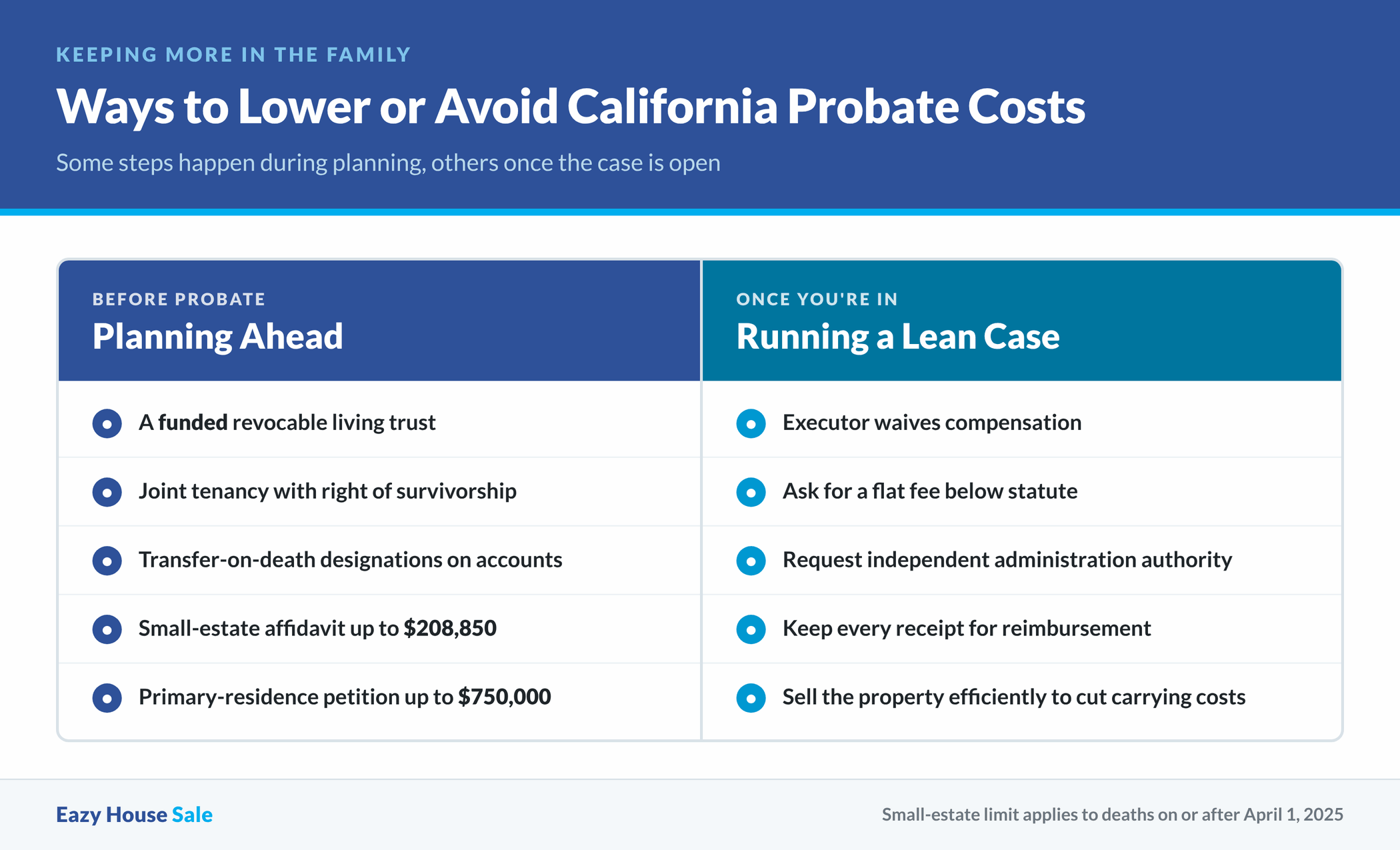
A funded revocable living trust is the best money you’ll ever spend on your own estate. Almost every California homeowner who skips one costs their kids five figures. Property held in a funded revocable living trust passes to beneficiaries without probate, so no statutory attorney or executor fee attaches to it. The catch is the word “funded,” though, since a trust document with the deed never transferred does nothing.
Small estates have a side door. The small-estate affidavit limit is $208,850 for deaths on or after April 1, 2025, and it holds until the next scheduled adjustment on April 1, 2028. Real property needs a separate route. That means the primary-residence petition under section 13151, capped at $750,000, or formal probate. With the California market where it is, many inherited houses blow past that cap.
Once you’re already in, you still have levers. Waiving executor compensation keeps that half of the schedule inside the family. A flat fee below statute is allowed, and a handful of California attorneys will agree to one on simple cases if you ask before you sign. Independent administration authority lets the executor sell the house without a separate court confirmation hearing each time. That trims both the calendar and the risk of extraordinary fees.
Selling the property efficiently is the other half of keeping probate cost down. A landlord in Whittier came to us months behind on the mortgage, with an auction date already on the calendar and a garage full of his late father’s tools. We closed in under three weeks. The lender got paid, and the estate kept equity that a trustee sale would have eaten. Speed did the heavy lifting.
If a probate sale is where you’re headed, look over the California Department of Real Estate consumer pages before you sign with anyone, agent or investor.
Frequently Asked Questions
What Is the Current Probate Limit in California?
California sets a dollar ceiling below which heirs can collect personal property with a sworn affidavit instead of opening a court case. The figure cited earlier applies to deaths on or after the spring 2025 effective date. Real estate is handled separately, through its own petition with a higher cap for a primary residence. Anything above those lines heads into full probate, and probate cost climbs from there.
What Is the Cheapest Way to Handle Probate?
If the estate qualifies for one of the simplified California procedures, that’s the cheapest path by a wide margin, because you skip the statutory schedule entirely. For estates that don’t qualify, the next best move is to ask the attorney for a flat fee below statute and have the executor waive compensation. A short case also keeps probate cost down, since carrying an empty California house is a monthly bill nobody plans for.
How Can I Get Around Probate Fees Entirely?
Planning ahead is the only reliable answer. A properly funded living trust moves assets outside the probate estate. So do joint tenancy with right of survivorship and transfer-on-death designations on accounts, and the statutory schedule never touches any of them. Once someone has passed without that groundwork, your options narrow to the simplified California procedures and a lean, fast case.
Does Selling the House Faster Reduce Probate Cost?
A quicker sale doesn’t shrink the statutory fees, since those ride on the appraised value instead of the calendar. What it cuts is everything else. Think insurance on a vacant property, utilities, yard care, property taxes, bond premiums in a second year, and the slow drip of maintenance surprises. For most California families, that’s where the savings you can actually recover live.
Who Pays Probate Costs Out of Pocket?
The estate covers probate cost, not you personally. An executor often fronts the first filing fee and the publication bill, then gets repaid later. If the estate is cash-poor and asset-rich, which describes most California probate cases involving a house, that repayment waits until something sells. Save every receipt from the first week forward.
Selling an Inherited House in Los Angeles
Los Angeles County’s median single-family price reached $994,670 in September 2026, according to C.A.R. In probate, that matters more than most families expect, since the statutory fees ride on the full appraised value.
Eazy House Sale buys inherited houses in Los Angeles and in other parts of California. Executors can get an as-is number early and plan the estate’s budget around it.
That includes estates with a house in Long Beach or nearby cities, where a long probate can stretch carrying costs.
Get a Straight Answer on Your Inherited House
If you’re facing a probate case with a house in it, you might want to know what the property would bring without repairs, showings, or a long listing period. We’re glad to talk it through. There’s no pressure or obligation, and no hard feelings if listing with an agent fits your family better. You can reach us anytime at Eazy House Sale, and we’ll give you a straight answer either way.
If you’re an executor or an heir with a house in the estate, you can ask questions before you decide anything. We’ll talk through the property, the timeline and what the estate might net.
Contact Eazy House Sale when it suits you, or use the short form below this post.
Helpful California Blog Articles
- Can Medical Bills Take Your House in California?
- What Taxes Do I Have to Pay When I Sell My House in California
- Can You Sell a House With a Mortgage in California
- How Much Does Probate Cost in California
- Should I Remodel My Kitchen Before Selling
- Selling House With Septic Tank Problems in California