
More than a million California homes run on a septic system instead of a city sewer. The State Water Board puts the count of onsite wastewater systems statewide at more than one million, from the hills of Sonoma County to the oak-covered lots east of Sacramento. I’ve walked through plenty of them during inspections. If you own one and the tank is acting up, septic tank problems will shape your sale more than your countertops ever could.
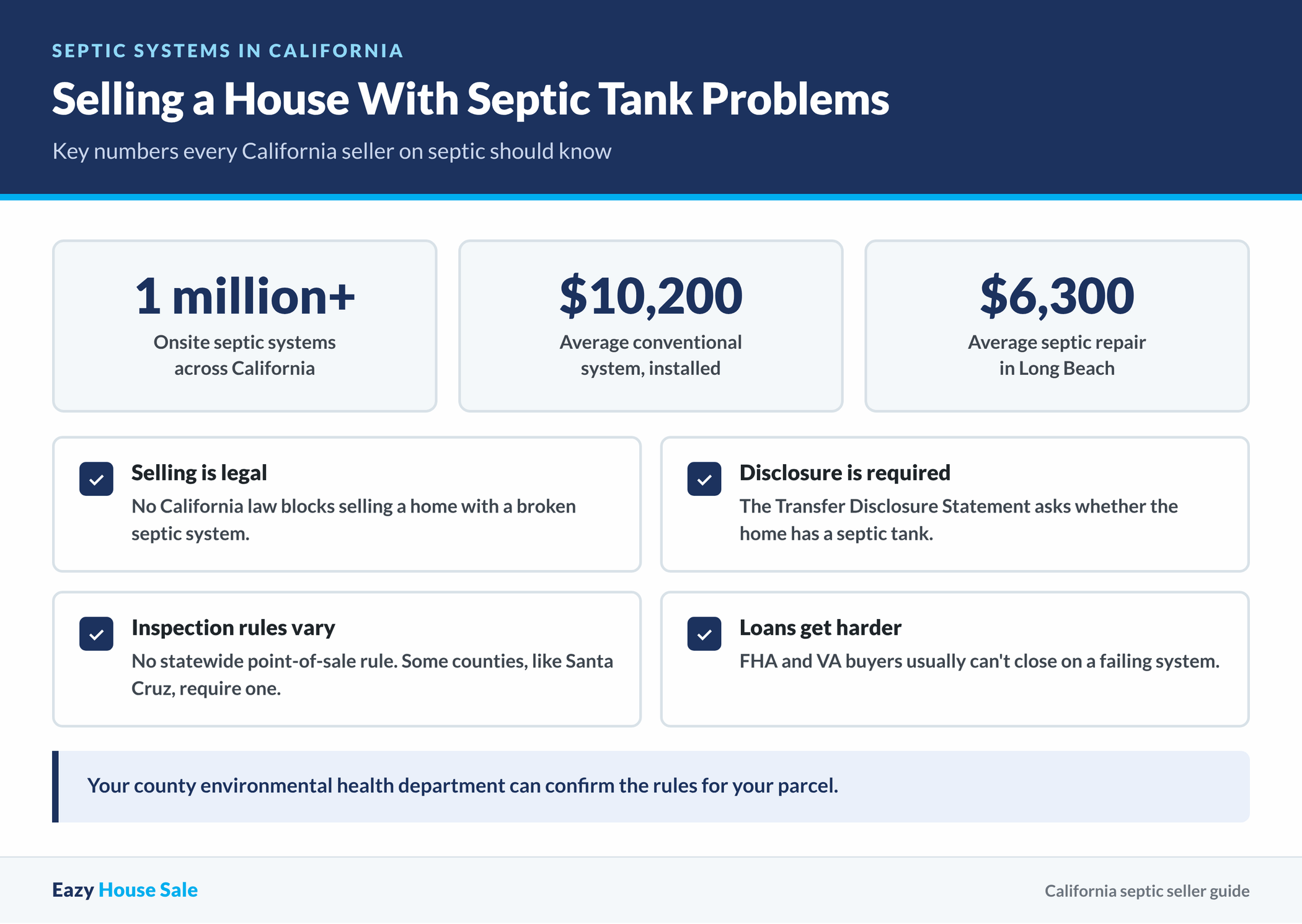
Can You Sell a House with Septic Tank Problems in California?
Even a $15,000 drain field repair in Sacramento won’t stop a sale from closing. Nothing in California law forbids selling a home with a broken onsite system. The sale isn’t illegal or blocked, and you don’t have to fix anything first. What the law does demand is honesty, which is a separate duty.
Most FHA and VA buyers can’t close on a home with a failing septic system, since their lenders want it working at the appraisal. Regular loans give more room. Loan reviewers still get nervous when an inspection report uses the word “failure.” That leaves cash buyers, rehab-loan buyers and investors, who simply price septic tank problems into their offers and move on.
Last year I bought a place in Vacaville from three siblings who inherited their father’s house. One of them had a job transfer and five weeks to move. His fishing gear still filled the garage when we walked through on a Tuesday. The leach field had been soggy for two summers, and nobody had time to dig up a yard. We closed around the condition instead of fixing it.
People underestimate how much timing matters in California. Homes statewide sat a median of 57 days on the market in October 2026, with a median list price of $719,000. Add escrow, an inspection contingency and a repair negotiation, and a listing can stretch past four months.
What Causes Septic Tank Problems in a California Home Sale?
A seller in Grass Valley pumped her tank, listed the house and had an offer in nine days.
In California, most septic tank problems don’t start the month you decide to sell. The damage usually began years earlier. Clay soils across the Central Valley hold water instead of draining it, so drain fields clog from the bottom up. Coastal homes near Half Moon Bay and Cambria face high groundwater, which leaves treated water with nowhere to go.
Age does a lot of the harm. Plenty of California homes built in the 1950s and 1960s still have their original concrete tanks. Sewer gases eat at the top of those tanks and corrode them from the inside.
Eucalyptus, oak and willow roots chase water straight into leach lines. By the time a toilet backs up, the lines are already packed. Missed pumping and heavy garbage disposal use add to the strain. So does a laundry habit that sends hundreds of gallons into the system in one afternoon.
Then there’s the hidden one: a tank that was never permitted. Counties here have issued septic permits for decades. Any system a past owner put in without paperwork shows up as a gap in the county file, and buyers and lenders treat that gap as a defect.
Has a technician ever pumped your tank and said the sludge layer looked fine? Pumping tells you almost nothing about whether the drain field can still absorb what the tank sends it.
Does California Law Require a Septic Inspection Before Selling?
No statewide rule forces a septic inspection at sale, and anyone who says otherwise is guessing. California leaves this to each county, so the answer depends on where your home sits.
In June 2012 the State Water Resources Control Board adopted the OWTS Policy. It lets local agencies, such as county environmental health departments, issue septic permits. You can read the framework on the State Water Board’s OWTS page.
Some California counties do require a point-of-sale inspection. Santa Cruz County, for one, requires an OWTS to be pumped and inspected by a qualified professional before a sale under an ordinance that took effect July 1, 2023. One county’s rule may not match the next county’s. Your county environmental health department can confirm what applies to your parcel, so don’t go by what a neighbor three counties over went through.
Disclosure works the same way everywhere in California. Civil Code section 1102 sets the seller disclosure rules through the Real Estate Transfer Disclosure Statement, and that form asks whether the property has a septic tank. Under section 1102.13, anyone who willfully or negligently skips a disclosure duty is liable for the buyer’s actual damages. You can see a copy of the state form on Nolo’s site if you want to see what you’d sign.
Buyers in California hire their own inspectors anyway. Any surprise found during escrow costs you leverage you’d have kept by finding the septic tank problems first.
How Much Do Septic Tank Problems Lower Your Home’s Value?
In Long Beach, septic repair work averages about $6,300, with a local range of roughly $2,100 to $11,500, according to Angi’s 2026 cost data. Numbers like those explain why buyers get nervous. California sits at the top of the national range for this work.
Replacement is where the math turns ugly. A conventional septic system in California averages about $10,200 installed. Most jobs land between $5,100 and $15,300, about 14 percent above the U.S. average.
Buyers deduct the repair estimate plus a cushion for anything the estimate might miss. The cushion is usually bigger than the bid itself. I once watched a $12,000 bid turn into a $30,000 price cut because the buyer’s agent argued the drain field might need an engineered redesign.
Location changes the hit. On a two-acre property in Penn Valley or Ramona, where every neighbor runs septic, the discount is smaller because buyers already understand the system. Homes at the edge of a sewered neighborhood in Santa Rosa take a bigger hit. Buyers there compare it with the sewer-connected house down the street.
When septic tank problems show up next to an aging roof or a dated electrical panel, buyers stop treating them as separate line items. They see the whole house as a project, and offers drop by a percentage instead of a dollar amount.
Where does your home fall in that spread? A quick call to your county health department about permit history will tell you more about your bargaining position than any online estimate.
Should You Repair or Disclose Septic Tank Problems Before Selling?
“If I fix it, I’ll get the money back at closing.” Usually you won’t. Septic work in California is buried pipe and tank. It returns pennies on the dollar next to a kitchen refresh. The appraiser credits a working system, not a brand-new one, so your value barely moves.
Repairs make sense in a few cases. A cracked distribution box or a fallen baffle is a modest fix that removes a scary line from the inspection report. Baffle, filter and distribution box repairs run roughly $200 to $900, and that money is well spent before you list.
Replacing a whole drain field before a sale is usually a mistake for a seller who’s already stretched. Drain field work typically runs $5,000 or more in California. County permits add weeks you may not have. Pulling permits, scheduling a perc test, waiting on plan review and then digging can eat two or three months.
Fixed or not, the problem goes on the form. Even a repaired system gets disclosed, with its repair history attached.
Price the issue into your asking price honestly and let the buyer decide how to solve it. The Transfer Disclosure Statement exists so California buyers can make an informed choice, and courts take it seriously.
If fixing septic tank problems would cost more than you’d get back, selling as-is to a buyer like Eazy House Sale takes the repair question off the table. We buy the condition, not the promise of one.

What Paperwork Do You Need to Sell a House with Septic Tank Problems?
A seller hands over the pumping receipt and assumes the file is done. Then the buyer’s lender asks for the original install permit. The county has no record of the system, and now you’re rebuilding forty years of history through a records request.
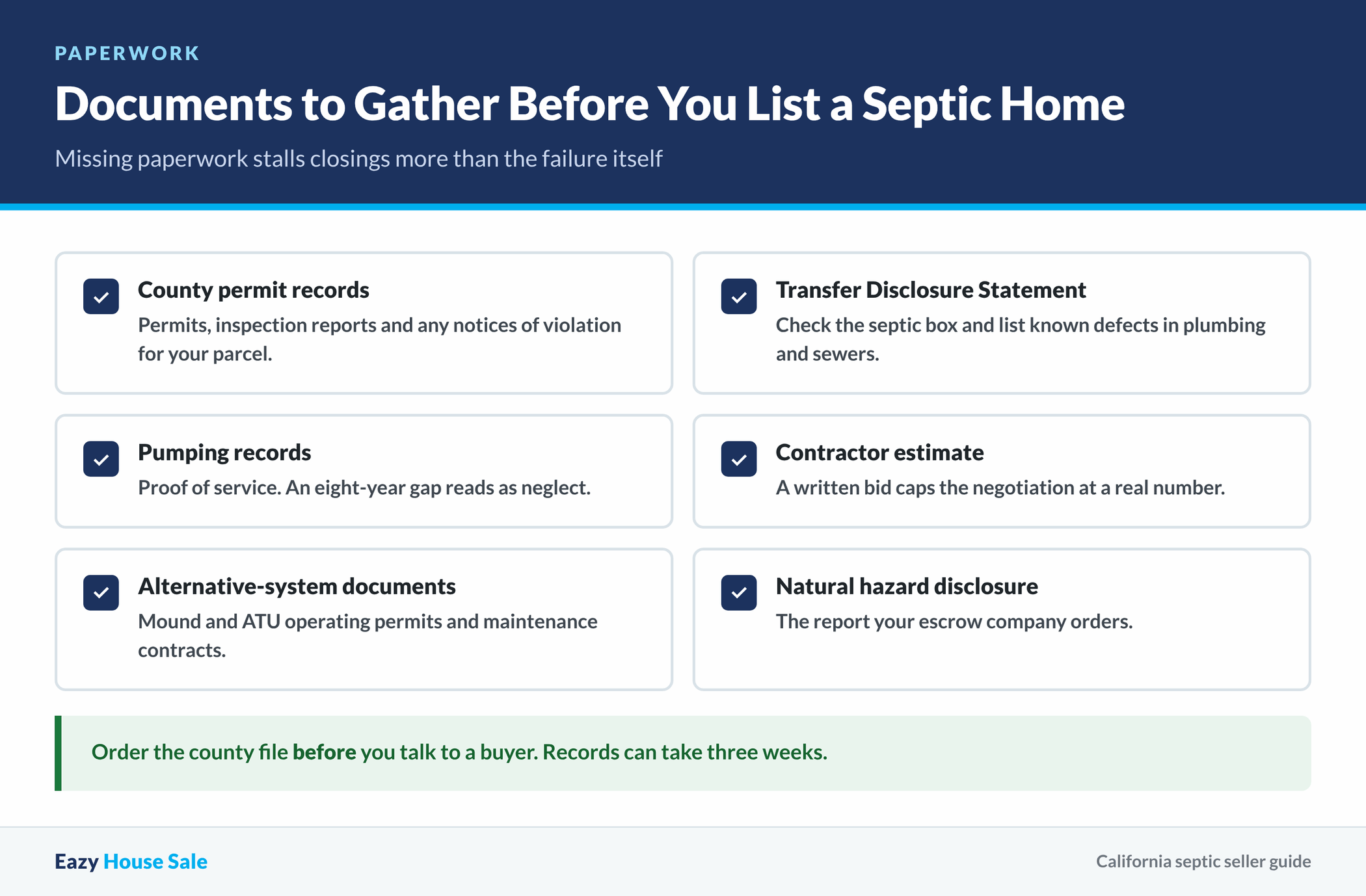
Start with your county environmental health department. It holds the permit records, inspection reports and any violation notices tied to your California parcel.
The Transfer Disclosure Statement sits at the center of the file. You’ll check the septic tank box, then say if you know of defects in plumbing or sewers. Known backups, surfacing effluent, county correction notices and past repairs all go there.
Pumping records carry real weight. A California buyer looking at a thirty-year-old system wants proof it was serviced. An eight-year gap in the service log reads as neglect, even when the tank is sound.
If a contractor gave you a written estimate for the repair, include it. Real bids cap the negotiation, since the buyer can’t invent a worse number.
Collect any paperwork for an alternative system if yours isn’t a standard gravity setup. Mound systems and aerobic treatment units come with operating permits and maintenance contracts that transfer with the home. California counties track those separately. Missing papers stall more closings than the mechanical failure itself does.
One more item belongs in the file: the natural hazard disclosure report your escrow company orders.
What Are Your Options for Selling a House with a Failing Septic Tank?
“Do I have to fix this before anyone will touch it?” No. You have four real paths, and each one trades money for time in its own way.
Listing on the open market with full disclosure works when you have runway. You price below similar sewer-connected homes and plan on cash-heavy offers. Some California buyers will still walk during the inspection period, no matter what you disclosed up front.
Repairing first and listing after gets you the widest buyer pool. It also means paying up front and sitting through permit delays. As of April 2026, a full conventional replacement in California ran $10,000 to $20,000. Mound and ATU systems reached $25,000 or more.
A repair credit splits the difference. The buyer closes, escrow holds back funds and the buyer handles the work after moving in.
Selling directly to an investor is the fourth path. You skip showings, the inspection contingency and the repair negotiation. The offer sits below retail, and anyone who says otherwise is selling you something. What the discount buys is a sure close and speed, which matter most when septic tank problems are getting worse.
No single answer fits everyone, and the right one matches your timeline and your bank account.
For California sellers leaning toward that last option, Eazy House Sale handles homes with septic tank problems across the state. We’ve bought inherited homes and rentals whose owners live three hundred miles away.

How Do You Avoid Delays When Selling a House with Septic Tank Problems?
For years I told sellers to hold off on the county records request until they had an offer. That advice cost people weeks they didn’t have.
Order the file first. Pull your permit history, pumping records and any county letters before you talk to a single buyer. California county offices move at their own pace. A three-week records wait inside a 30-day escrow is how sales fall apart.
Get your own inspection next. A qualified California septic pro will tell you if you’re facing a $600 fix or a full replacement. Everything else in your plan depends on that answer. Los Angeles septic repairs average $6,414 and range from $2,129 to $10,700, so guessing helps nobody.
Line up a contractor who can talk to the buyer’s agent directly. Sales stall when two sides argue about a condition neither one understands. One ten-minute call from the person who crawled the drain field settles more disputes than another round of counteroffers.
Tell buyers about the septic tank problems in the listing itself. Hiding them until the inspection report surfaces guarantees a renegotiation, and in California escrows that can add two to three weeks. Telling them up front screens out the buyers who were never going to close.
A homeowner in Lodi called me three months behind on his mortgage, with the auction date already posted. His leach field had surfaced in the side yard the winter before. He’d been paying a hauler to pump the tank every six weeks just to keep the house livable. We closed before the sale date because nothing in our transaction depended on fixing the system.
Speed doesn’t come from a generous buyer but from removing every step that needs a third party’s permission.
Frequently Asked Questions
How Long Does a Septic Inspection Stay Valid?
Most California buyers and lenders treat an inspection as current for six months to a year, though no state rule sets the number. Your county environmental health department may set its own window where a point-of-sale inspection is required. If your report is older than one selling season, plan on the buyer ordering a new one, especially after a wet winter.
What Does It Cost to Put in a New Septic System in California?
Costs here run above the national average because of permits, engineering and soil, and the figures earlier in this article give the realistic range. Hard soil, steep slopes or a protected watershed can push you toward a mound or aerobic system at the top of that range. County permit fees and the perc test are part of the total, not extras.
Should I Avoid Buying a House That Has a Septic Tank?
Not at all. Many desirable California homes on larger lots have no sewer access, and a well-kept system can last for decades with routine pumping. What you should avoid is buying one without a thorough inspection and a look at the county permit file. Septic tank problems are manageable when you know about them going in and they’re priced into your offer.
Can I Sell As-is and Still Have to Disclose Septic Tank Problems?
Yes, and this trips up sellers all the time. An as-is clause in a California sales contract sets expectations about repairs. It doesn’t erase your duty to disclose what you know on the Transfer Disclosure Statement, so sell in any condition you like and put the problems on the form.
Will a Cash Buyer Still Want an Inspection?
Usually, yes, though it works differently. A cash buyer or investor inspects to price the house, not to build a list of demands, and no lender approval hangs on the result. That’s why these sales close faster even when septic tank problems are severe.
If you’re staring at a failing system and wondering whether to dig, disclose or just be done with the house, we’re glad to talk it through. There’s no pressure, no obligation and no hard sell if selling isn’t the right move for you.
Septic Homes and the Los Angeles County Market
Los Angeles County’s median price was $994,670 in September 2026, up 1.2% from a year earlier, according to C.A.R. A failing tank can pull a house well below that number once a buyer’s inspector writes it up.
If you have questions before you call, you can read common questions for Eazy House Sale.
Talk Through Your Septic Problem Before You Sell
Tell us what the inspector found, or what you think is wrong with the tank. We’ll give you an as-is cash offer and a straight read on whether repairs would pay off before a listing.
Contact Eazy House Sale when it suits you, or use the short form below this post.
Helpful California Blog Articles
- Can Medical Bills Take Your House in California?
- What Taxes Do I Have to Pay When I Sell My House in California
- Can You Sell a House With a Mortgage in California
- How Much Does Probate Cost in California
- Should I Remodel My Kitchen Before Selling
- Selling House With Septic Tank Problems in California